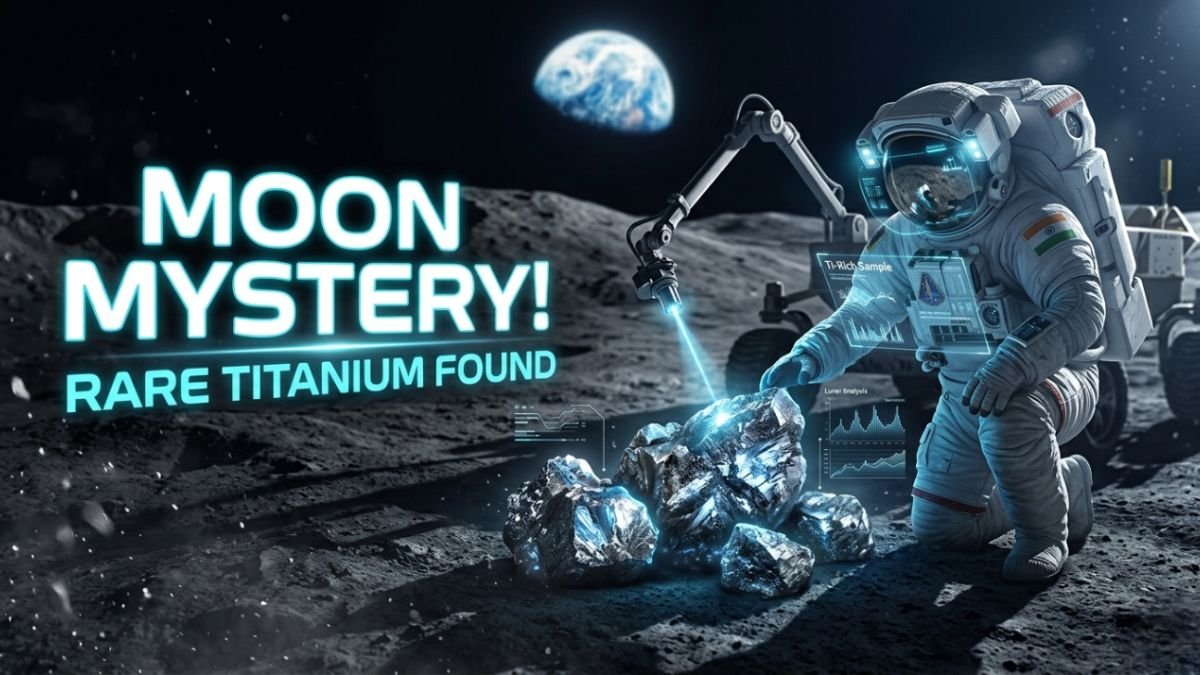
The Moon has long been a focal point of human curiosity, yet in recent years, scientific interest in it has intensified even further. Now, new Indian research has deepened our understanding of the Moon. A study conducted by scientists from the Indian Institute of Technology Kharagpur and the Physical Research Laboratory explains in detail the formation process of rare titanium-rich rocks found beneath the lunar surface.
This research not only sheds light on the Moon’s early history but also could play a pivotal role in planning India’s upcoming Chandrayaan-4 mission.
The Origin of the Moon and the Magma Ocean Hypothesis
According to scientists, during the early stages of the Moon’s formation, its entire surface was covered by a vast magma ocean. This state is believed to have existed approximately 4.3 to 4.4 billion years ago.
At that time, the Moon experienced extreme temperatures and pressures, resulting in its entire surface being filled with molten material. As this magma gradually began to cool, the heavier minerals within it began to sink, while the lighter elements rose to the surface.
During this process, layers known as Ilmenite-Bearing Cumulates (IBC) were formed; these layers are rich in titanium. It is these very layers that now provide crucial insights into the Moon’s internal structure.
A Study Conducted by Recreating Lunar Conditions in the Laboratory
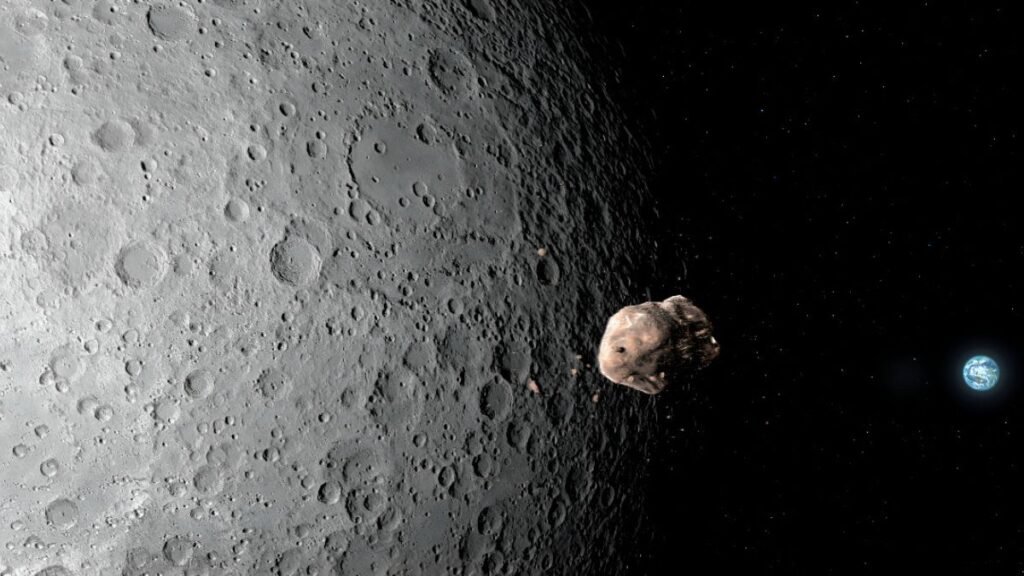
To comprehend this complex process, scientists recreated lunar-like conditions within a laboratory setting.
They subjected rock samples to a pressure of approximately 3 gigapascals and temperatures exceeding 1500 degrees Celsius. These conditions mirror the environment that existed deep within the Moon billions of years ago.
Under these conditions, the rocks underwent partial melting, producing materials that bore a striking resemblance to the titanium-rich basalts found on the Moon.
This experiment demonstrates that complex geological processes—much like those on Earth—have indeed been taking place within the interior of the Moon. The Deep Connection Between Temperature and Magma Formation
A key finding of this research is that temperature plays a pivotal role in the formation of magma.
When temperatures are high, magmas with moderate titanium content are formed, which gradually evolve into intermediate-Ti basalts.
Conversely, magmas formed at lower temperatures possess a higher titanium content; over time, this content becomes even more enriched, while the magnesium content simultaneously decreases.
It is precisely this distinction that accounts for the diversity observed in the rock samples collected by various lunar missions.
Lunar Interior Dynamics: Not Static, but an Active Structure
This study has also revealed that the Moon’s interior is not entirely static.
Molten material is in constant motion, moving both upward and downward. In regions of lower pressure, this material rises—a process that can trigger volcanic activity.
Conversely, in regions of higher pressure, the material descends. This process is termed “Mantle Overturn,” and it involves the continuous redistribution of material within the lunar interior.
This discovery challenges the long-held assumption that the Moon is a completely inert celestial body.
Significance for the Chandrayaan-4 Mission
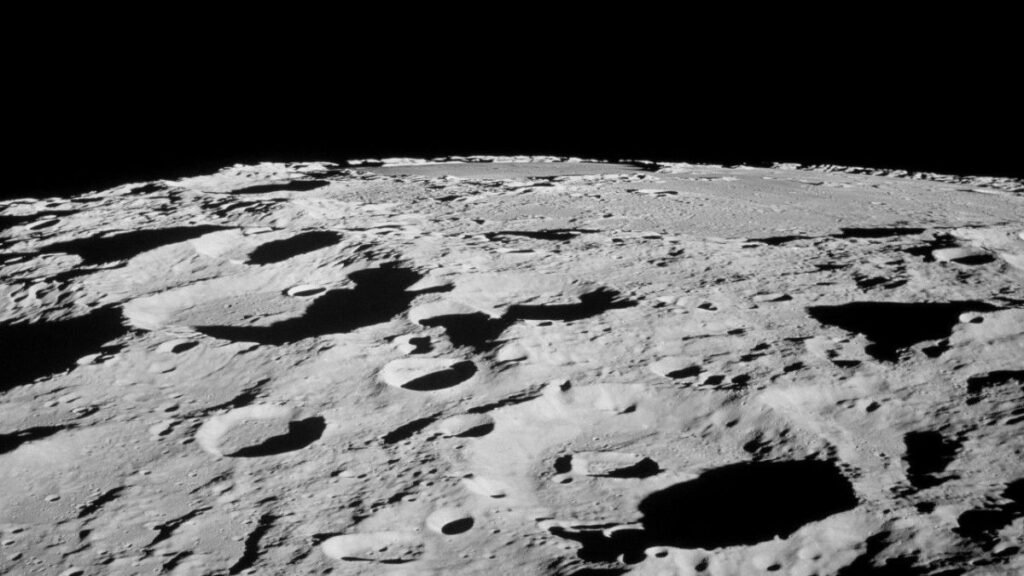
This research could prove immensely valuable for the Indian Space Research Organisation’s (ISRO) upcoming Chandrayaan-4 mission.
The primary objective of Chandrayaan-4 is to collect samples from the Moon and return them to Earth. Selecting the optimal landing site for this endeavor constitutes the most critical step.
Through this study, scientists can identify specific regions on the Moon where titanium-rich rocks are likely to be present. Areas surrounding the South Pole, in particular, are currently being regarded as scientifically significant targets.
Collecting samples from the precise locations identified by this research will yield more accurate and comprehensive insights into the Moon’s history and its internal structure.
India’s Role in Global Space Research
India’s space program continues to scale new heights. Missions undertaken by the Indian Space Research Organisation—such as Chandrayaan-1, Chandrayaan-2, and Chandrayaan-3—have already established a strong global identity for India.
Now, through Chandrayaan-4, India is poised to take another major step toward unraveling the deep mysteries of the Moon.
This research demonstrates that India is not only capable of launching space missions but is also playing a leading role in the field of scientific inquiry.
Future Prospects: Thinking Beyond the Moon
The discovery of titanium-rich rocks is not limited merely to scientific curiosity; it could also prove significant for the utilization of resources in the future.
Titanium is an exceptionally strong yet lightweight metal, widely used across the aerospace and industrial sectors. If sufficient quantities of it exist on the Moon, it could potentially be utilized in future space missions.
Furthermore, research of this nature serves to prepare us for the study of other planets and celestial bodies.
Conclusion: A New Layer of Lunar Mysteries
This study, conducted by the Indian Institute of Technology Kharagpur and the Physical Research Laboratory, marks a significant step toward understanding the Moon’s internal structure and its evolutionary history.
This research is not only scientifically significant but also opens up new avenues for future space missions and resource utilization.
These lunar mysteries remind us that there remains much to be discovered in the cosmos—and India is rapidly forging ahead in this race of exploration.
FAQs
Q. What is the new study about?
A. It explains how titanium-rich rocks formed on the Moon billions of years ago.
Q. Who conducted this research?
A. Scientists from IIT Kharagpur and the Physical Research Laboratory.
Q. Why are titanium-rich rocks important?
A. They help scientists understand the Moon’s internal structure and history.
Q. How does this help future missions?
A. It helps in selecting better landing sites for Chandrayaan-4.
Q. Is the Moon’s interior active?
A. Yes, the study suggests there is movement of molten material inside the Moon.