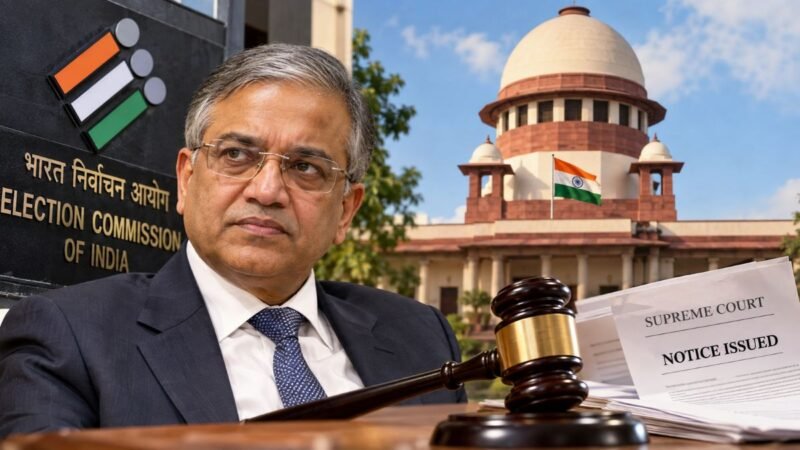
The Supreme Court has refused to do anything ex parte (unilateral) about the petition touching Chief Election Commissioner (CEC) Gyanesh Kumar, in a way. The court turned down the plea to suspend the CEC ex parte, and instead it put out a notice in the matter, so it can proceed from there. After this call, the related parties will now be able to place forward their own versions of events and arguments. The whole issue comes from a petition that challenges some decisions made by the Election Commission, and the Court will take up the legal angles of the dispute at upcoming hearings.
Supreme Court Refuses Immediate Suspension
In this case, the petitioner had sought the ex parte suspension of Chief Election Commissioner Gyanesh Kumar. However, the Supreme Court refused to issue such an order without hearing the concerned party , and it was quite clear on that point. This stance reflects a fundamental principle of the judicial process, namely that hearing a person, or even a constitutional office-holder, is crucial before serious action is taken against them. In other words, they can’t just do it in a hurry , without giving opportunity for response.
What is Ex Parte Action?
“Ex parte” refers to an action where the court passes an order without one party being there, or without hearing them properly. In this instance, the petition was aiming for immediate relief, or at least an order concerning the CEC’s suspension. But the Supreme Court didn’t think that kind of step was suitable right now, at this stage, and it decided to go along with the usual legal process instead.
CEC Gyanesh Kumar Gets Interim Relief
The Supreme Court’s stance has sort of given interim relief to CEC Gyanesh Kumar. But that doesn’t mean the Court has dismissed all the allegations or claims that are in the petition, not at all. Instead it just declined the request for an immediate and unilateral suspension, that’s all. In the upcoming hearings, arguments and responses from both sides will be placed before the Court so they can weigh it properly.
Petition Challenging ECI Decisions
This matter is not only limited to the CEC office, because it also relates to a petition that is challenging certain particular decisions by the Election Commission of India (ECI). The petition is basically questioning the legal, validity of the Commission’s decisions and the problems that come around those decisions, in general. So, the Supreme Court’s upcoming hearing could become really important for dealing with the wider, bigger sides of this dispute.
Supreme Court issues notice
The court has issued a notice in the matter, meaning that responses have been sought from the concerned parties. The parties served with the notice can now present their stance and legal arguments before the court. Subsequently, the Supreme Court will determine the future course of action based on the available facts and arguments.
Court avoids hasty decision
A key aspect of this hearing was the Supreme Court’s emphasis on advancing the due process rather than issuing an immediate, harsh order. A balanced approach is vital for courts when dealing with matters involving constitutional bodies and their heads. Therefore, the path of issuing a notice to hear the concerned parties was adopted.
Why is the CEC post significant?
The Chief Election Commissioner plays a pivotal constitutional role in the country’s electoral system. The Election Commission of India bears significant responsibility for conducting and overseeing elections and related processes. Naturally, any legal dispute involving the CEC attracts widespread public and political attention.
What is the immediate impact of this decision?
For now, the most direct consequence of the Supreme Court’s stance is that the unilateral suspension action sought against CEC Gyanesh Kumar has not been immediately implemented. However, the final outcome will depend on future hearings and court orders; thus, it would be premature to view this as the final verdict on the matter.
Focus shifts to the next hearing
The next crucial phase involves the responses from the concerned parties and the subsequent court hearings. The Supreme Court will examine the legal basis of the issues raised in the petition and consider the facts presented regarding the challenged decisions of the ECI.
What is the current takeaway?
Simply put, the Supreme Court has not immediately acceded to the demand for the ex parte suspension of CEC Gyanesh Kumar. Instead, the Court has chosen to issue notices to the concerned parties to hear their side. This implies that the dispute is far from over, and a final conclusion will emerge only after further judicial proceedings. For now, the most significant takeaway is that the CEC has avoided immediate unilateral suspension, even as the legal process regarding the challenge to the ECI’s decisions continues.