
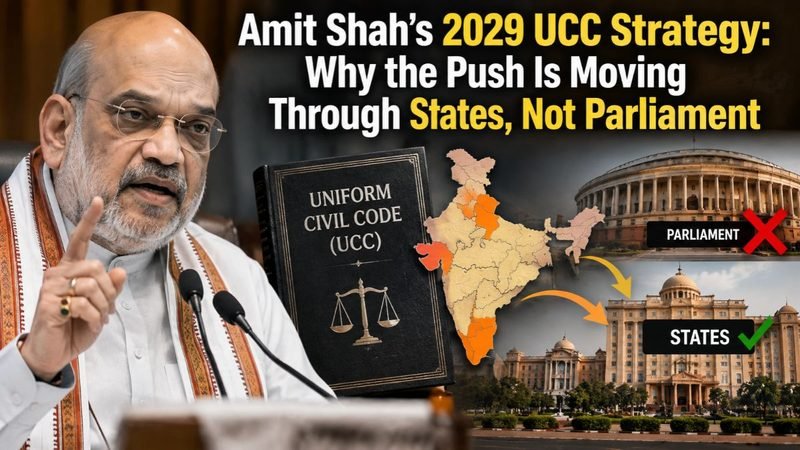
The Uniform Civil Code (UCC) has long been a subject of discussion in Indian politics. Now, with the 2029 Lok Sabha elections in sight, political activity surrounding the UCC appears to be intensifying once again. The role of states seems particularly crucial in Amit Shah’s strategy as Union Home Minister. Why is there such an emphasis on moving towards the UCC through the states rather than directly through Parliament.
Why is the UCC issue back in the spotlight?
The objective of the UCC is to establish a uniform set of civil rules to replace the personal laws that currently exist for different religious communities. Matters such as marriage, divorce, inheritance, and adoption could fall within its ambit. Consequently, it is not merely a legal issue but also a highly sensitive political one.
Strategy with 2029 in mind
Preparations for major political issues begin well in advance, even though the 2029 Lok Sabha elections are still some time away. The UCC has been one of the BJP’s core ideological issues. Therefore, efforts to keep it part of the political and policy agenda in the coming years could prove significant.
Why is the role of states important?
In India, many subjects related to personal laws are influenced by the shared legislative framework between the states and the Centre. Some states have already taken steps towards implementing a Uniform Civil Code at their own level. This provides the Centre with an opportunity to understand how such a system can be implemented across different states.
Uttarakhand emerges as a major example
Uttarakhand took a significant step towards implementing the UCC, a move viewed as an experiment for the rest of the country. This raised the question of whether a model initiated at the state level could subsequently be adopted by other states.
A path distinct from introducing legislation directly in Parliament
Introducing comprehensive UCC legislation in Parliament could trigger intense political and social debate. The strategy of proceeding in a phased manner through the states offers a different approach. This can help the government gauge reactions from various regions and assess potential challenges.
Building Political Consensus Across States
Viewing the UCC merely as a legal change is insufficient; it carries significant social and political implications. Building support through discussions, committees, and policy formulation at the local level across various states could be a crucial part of this process.
Political Significance of the UCC for the BJP
The UCC has long been a key item on the BJP’s agenda. Consequently, keeping this issue active in the run-up to 2029 could be linked to both the party’s ideological foundation and its electoral strategy. However, the ultimate political impact will depend on public reaction.
A Major Issue for the Opposition as Well
Opposition parties do not hold a uniform view on the UCC. While some question the very concept of a uniform law, others express concerns regarding the implementation methods and the scope of such legislation. Therefore, debates on the UCC in various states could influence the political discourse between the Centre and the Opposition in the near future.
The Biggest Challenge—Social Consensus
The greatest challenge in implementing the UCC lies not merely in enacting legislation but in forging broad social consensus. Given India’s religious and cultural diversity, it will be essential to understand public concerns and ensure clarity in the rules.
What Lies Ahead?
Discussions and policy-related activities concerning the UCC are likely to intensify across several states in the coming years. If distinct models emerge in different states, the Centre will gain valuable experience and precedents for formulating a comprehensive future policy. Thus, the politics surrounding the UCC leading up to 2029 may not be confined to parliamentary debates but could also play out at the state level.
Conclusion
To understand Amit Shah’s UCC strategy for 2029, the most critical point is that states can serve as platforms for experimentation and building political consensus. Rather than immediately enacting a sweeping law in Parliament, state-level initiatives offer the government an opportunity to gauge ground-level reactions. However, the future of the UCC will not be determined solely by political strategy; constitutional processes, legal scrutiny, and broad social consensus will also play pivotal roles.