
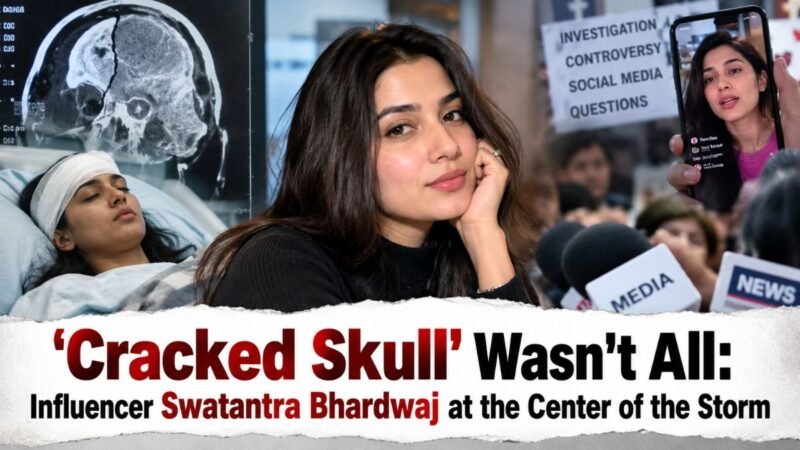
Swatantra Bhardwaj has suddenly become a subject of national discussion following ‘Cracked Skull’ a viral podcast clip on social media. The matter stems from a protest at Delhi’s Jantar Mantar, where a controversy arose regarding an alleged assault on a protester’s father. In the viral video, Bhardwaj is seen speaking in a highly aggressive manner while referring to this incident. Subsequently, questions regarding his statement began to circulate across social media, political circles, and the media. However, to fully understand the situation, it is essential to consider the police statement and his own subsequent clarification alongside the viral claims.
The controversy originated from the Jantar Mantar incident
The root of this entire controversy lies in a protest held at Delhi’s Jantar Mantar. According to the police, a man named Sanjay Kumar sustained a head injury during the protest. The names of Swatantra Bhardwaj and another individual surfaced in connection with the matter. Following the incident, the police registered a case based on a complaint and initiated an investigation. This is the same incident that later sparked a major political and social media controversy due to the viral podcast clip.
How the ‘Cracked Skull’ statement went viral
The controversy intensified when a video from a podcast began spreading rapidly on social media. According to reports, Bhardwaj allegedly claimed in the video that he had cracked the protester’s father’s skull and yet did not have to go to jail. This statement immediately grabbed public attention, and demands for action against him grew louder. However, since it is not appropriate to accept a viral clip as absolute fact without the full context, an official investigation into the matter becomes crucial.
Police presented a different picture regarding the skull fracture claim
A significant aspect of this controversy is the official statement from the Delhi Police. According to the police, while Sanjay Kumar did sustain a head injury, the medical examination described it as a simple injury, and the claim of a skull fracture was not supported by the medical report. The police also stated that the injury was allegedly caused by a kada (metal bracelet) being worn, rather than by a weapon. Thus, a clear discrepancy is evident between the viral “cracked skull” claims and official medical information.
Bhardwaj later distanced himself from his statement
Following the viral video, a clarification was also issued by Swatantra Bhardwaj. He reportedly denied making such statements and dismissed the video as fake. He further claimed that he had acted in self-defense during the incident and that the situation could have become dire for him had he not done so. Consequently, the matter involves claims from the viral video on one hand and Bhardwaj’s subsequent clarification on the other; a definitive assessment can only be made based on the investigation and legal proceedings.
Controversy regarding political connections
The controversy intensified after he reportedly mentioned his connections to and influence among political leaders during a podcast. This raised questions about whether political contacts helped him evade action. Conversely, the Delhi Police dismissed allegations of political interference, stating that action was taken in accordance with legal procedures. Therefore, claims regarding political patronage should currently be viewed as allegations and points of contention rather than established facts.
Police action regarding arrest and investigation
As the controversy escalated, the police detained Bhardwaj from Bulandshahr, Uttar Pradesh. According to reports, he was apprehended in connection with an alleged assault case at Jantar Mantar, and the court subsequently remanded him to one day of police custody. The police had already stated that questioning had taken place and that further action would proceed according to the law. This makes it clear that, following the viral video, the matter was not confined to social media debates but extended to police and judicial proceedings.
His pre-existing social media presence
Swatantra Bhardwaj was active on social media even prior to this incident. Reports indicate that he portrayed himself as a “Sanatani Yodha” (Sanatani Warrior) on his online profiles and shared highly aggressive content regarding political and social issues. His social media posts and videos had earned him recognition among a specific political audience. This is why, following the controversy, their past online activities also came under scrutiny.
The controversy was not limited to allegations of physical assault alone
Statements made on podcasts and social media further escalated the controversy. Media reports have highlighted several of their contentious and inflammatory views, as well as comments made regarding specific communities. Consequently, the discourse moved beyond the alleged assault at Jantar Mantar to broader questions concerning political rhetoric, public influence, and the responsibilities associated with a social media presence.
Questions regarding the responsibility of social media influencers
This entire episode has raised a significant question: shouldn’t individuals with a vast reach on social media bear a heightened responsibility for their words and statements? A viral video can reach millions within hours and impact real-world conflicts. Especially when dealing with issues of violence, political affiliations, or serious allegations against an individual, it is crucial to consider facts and the full context rather than relying on sensationalist claims.
What is the next crucial step?
The most critical aspects going forward will be the ongoing legal investigation and the available evidence. The police have presented their version regarding the injuries, medical reports, and the alleged assault, while Bhardwaj has offered his explanation, citing self-defense and video footage.
Therefore, rather than relying on the various narratives circulating on social media, it is more appropriate to focus on information emerging from the investigation, medical records, witness testimonies, and court proceedings. Ultimately, the controversy surrounding Swatantra Bhardwaj illustrates how a viral statement can transcend social media debates to become a significant political and legal issue.
Conclusion
Swatantra Bhardwaj case has evolved far beyond the initial viral claim of a “cracked skull.” The alleged assault at Jantar Mantar, the viral podcast, allegations of political patronage, the police’s clarification, his own defense regarding the incident, and his subsequent detention—all these events have escalated the controversy. While claims are spreading rapidly on social media, any final conclusion regarding this matter must be drawn solely based on the legal investigation and verified facts.