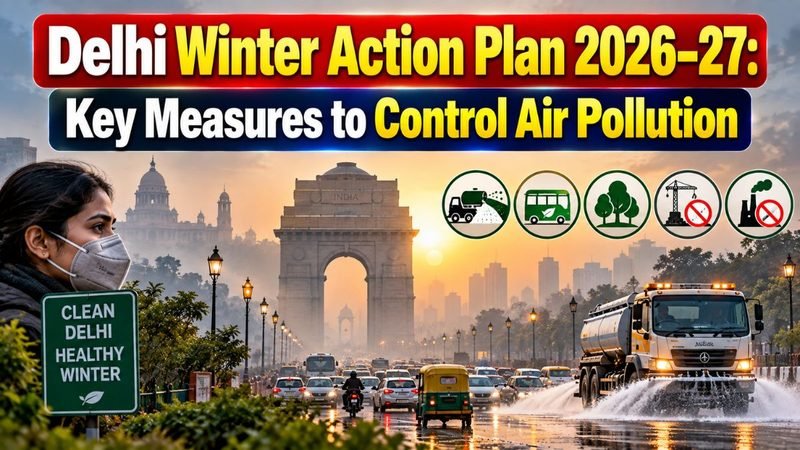
Delhi’s winter air pollution problem returns every year, as cooler temperatures, low wind speeds, and atmospheric conditions can trap pollutants close to the ground. With the winter season approaching, the Delhi government has announced its Winter Action Plan 2026–27, introducing a series of preventive measures aimed at reducing emissions from vehicles, construction, road dust, and daily commuting.
The plan is designed to bring several restrictions into effect before pollution reaches its worst levels, rather than relying only on emergency measures after air quality deteriorates. Here is a quick review of the major measures announced for the 2026–27 winter season.
Construction and Demolition Activities Face Major Restrictions
One of the most significant parts of the plan focuses on construction and demolition, which can generate large amounts of dust and particulate matter. According to the announced schedule, dust-generating demolition and outdoor civil construction activities will face restrictions from November 1, 2026, to January 31, 2027.
A more stringent measure is scheduled for the peak winter period. A complete ban on construction and demolition activities is planned from December 10, 2026, to January 20, 2027.
The idea is to reduce one important source of airborne dust during the period when Delhi’s atmosphere is particularly vulnerable to pollution buildup.
Parking Charges Will Be Doubled
The government is also using the parking policy as part of its pollution-control strategy. Parking charges at authorised parking facilities are scheduled to double from November 1, 2026, through February 28, 2027.
The measure is intended to discourage unnecessary private-vehicle use and encourage people to consider alternatives such as public transportation. Parking facilities owned and managed by the Delhi Metro Rail Corporation (DMRC) are reportedly excluded from the revised charges.
For regular commuters, this could make parking costs an important consideration when deciding how to travel during the winter months.
A Stronger “No PUCC, No Fuel” Rule
Vehicle emissions remain an important part of Delhi’s pollution-control strategy. Under the new measures, petrol, diesel, CNG, and LPG outlets in Delhi are required to provide fuel only to vehicles with a valid Pollution Under Control Certificate (PUCC).
An enforcement drive is scheduled to begin from October 1, 2026, with checks planned at fuel stations. The government has also discussed using technology such as automatic number-plate recognition to identify vehicles without valid certificates.
For vehicle owners, this makes checking the validity of their PUCC an important step before the winter restrictions become more stringent.
Restrictions on Older and Higher-Emission Vehicles
The winter plan also includes measures targeting vehicles that produce higher emissions. Reports on the government’s announcement indicate that restrictions will apply from November 1 to certain vehicles registered outside Delhi and vehicles below the BS-VI emission standard, with exemptions reported for CNG and electric vehicles.
The intention is to reduce the number of higher-emitting vehicles entering or operating in the capital during the winter pollution season.
Such measures are particularly relevant because Delhi experiences substantial daily movement of vehicles between the capital and neighboring NCR areas.
50% Work From Home During the Winter Period
Another major change could affect office workers. The government has announced a 50% work-from-home arrangement for government and private offices during the specified winter period.
Under the arrangement reported for November 1, 2026, to February 28, 2027, half of the workforce would work from home while the remaining employees would work from offices, subject to the applicable arrangements.
Reducing the number of people travelling to workplaces each day could help lower traffic volumes and associated vehicle emissions. For businesses and employees, however, the measure will also require advance planning around schedules, meetings, and workplace operations.
Staggered Office Timings to Reduce Traffic Pressure
The government is also introducing staggered timings for offices. Reported schedules indicate that MCD offices will operate from 8:30 a.m. to 5 p.m., while GNCTD offices will operate from 10 a.m. to 6:30 p.m. during the relevant winter period.
The purpose is to spread commuting across different time windows rather than having large numbers of employees travel simultaneously.
This approach links traffic management directly with pollution control. Fewer vehicles moving during the same peak hours can potentially reduce congestion, idling, and associated emissions.
Greater Attention to Road Dust
Road and construction dust remain important concerns in any city dealing with particulate pollution. Delhi’s broader pollution-control efforts include road redevelopment, dust-control activities, and other measures designed to reduce particles entering the air.
Recent reporting on MCD’s roadwork program noted that a substantial portion of its targeted roadwork remained incomplete ahead of the winter pollution season.
This highlights an important part of the winter plan: reducing pollution is not only about restricting activities but also about completing preventive infrastructure and maintaining roads properly before pollution conditions become severe.
Vehicle Fitness and End-of-Life Vehicle Checks
The winter strategy also includes stronger enforcement against vehicles that may contribute disproportionately to emissions. The government has discussed checks on end-of-life vehicles and fitness testing for around 2.5 lakh vehicles.
These checks are intended to identify vehicles that do not meet required standards and address pollution from poorly maintained or aging vehicles.
For motorists, the broader message is clear: vehicle documents, pollution certificates, and vehicle condition are expected to receive greater attention as winter approaches.
Pollution Control Will Require NCR Coordination
Delhi’s air does not stop at the city border, which makes regional coordination an important part of the pollution discussion. Government officials have highlighted the contribution of surrounding NCR areas and the need for coordinated action across the region.
This means Delhi’s winter strategy cannot operate entirely in isolation. Traffic entering the capital, industrial activity, construction, road dust, and other pollution sources across neighboring areas can all affect Delhi’s air.
Coordination between Delhi and surrounding NCR authorities will therefore remain important as the winter season progresses.
Implementation Before Pollution Peaks Is the Key Test
Perhaps the most important feature of the Winter Action Plan 2026–27 is its emphasis on preventive action. Instead of waiting until pollution reaches extremely poor or severe levels, several measures are scheduled to begin from November 1, while some vehicle-related enforcement begins earlier.
The plan combines restrictions on construction, parking measures, vehicle checks, PUCC enforcement, work-from-home arrangements, and staggered office timings.
However, announcing measures is only the first step. Their effectiveness will depend on consistent enforcement, coordination between agencies, and compliance from residents, businesses, and commuters. Delhi’s winter air quality is influenced by multiple sources and weather conditions, so no single measure can address the entire problem.
Final Takeaway
Delhi’s Winter Action Plan 2026–27 represents a broad attempt to prepare for the city’s recurring winter pollution challenge. The measures affect several everyday activities, from construction and parking to commuting, vehicle certification, and office schedules.
For residents, the practical takeaway is to keep vehicle pollution certificates updated, stay informed about traffic and construction restrictions, and plan commuting arrangements ahead of the winter period. The real impact of the plan will ultimately depend on how effectively these measures are implemented and how consistently pollution sources are controlled across Delhi and the wider NCR.