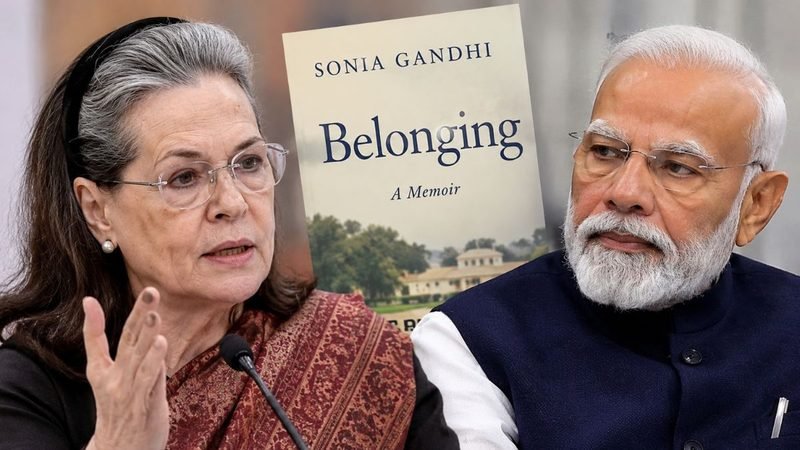
In Indian politics Sonia Gandhi and Prime Minister Narendra Modi are two big names, and their political ideologies plus how they actually work day to day often look like they’re moving in opposite directions, even if the broader stage is the same. Their differences are sort of well known already, but Sonia Gandhi, in her memoir “Belonging”, talks about how she had limited personal interaction with Narendra Modi, and she also points out some common threads. That little note is seen as politically meaningful, because it can, in theory, open up a conversation on how personal experience and direct dialogue between people with opposing worldviews can matter inside the nations political landscape.
Sonia Gandhi’s book ‘Belonging’ in the spotlight
Sonia Gandhi’s memoir, ‘Belonging’ ,kind of serves as an important window into her life and also the whole political journey, plus her personal experiences. Through the book she opens up several different facets of her life, like giving readers a better sense of her personal relationships, those individual moments, and her own view of the country’s political climate, it’s not just one straight story you know. In that setting, her mention of limited interaction with Narendra Modi stands out in a very particular way.
Limited personal interaction with Narendra Modi
Sonia Gandhi says her personal run-in with Narendra Modi has been kind of limited, and that suggests that beyond the usual formal political stuff, plus public forums , there weren’t that many moments for real personal engagement between them. Since they come from different political camps and also have distinct responsibilities, it’s not very surprising if their personal interaction stays rather minimal , like for long stretches.
Commonalities despite political differences
Perhaps the most intriguing part in Sonia Gandhi’s account is her suggestion that despite limited interaction, there is a sort of common ground or something close to it. While political leaders are usually framed by their ideologies and party platforms, they can also show quiet resemblances on a personal level, or at least a parallel tone, even if it comes from specific political matters shared experiences , or individual perceptions. But this really shouldnt be taken as proof of anything bigger, like some broader political consensus between the two leaders.
The Importance of Diverse Ideologies in Indian Politics
India’s democracy is based on a few ideologies, various political parties, and different viewpoints. There has been a old fashioned political rivalry going on between the Congress and the Bharatiya Janata Party (BJP). You often see disagreement between the two groups, over their policy direction and what they think is most important, sometimes it feels like a constant back and forth. But still, in a democracy, it’s kind of necessary that leaders who hold different opinions start conversations ,and try to get the gist of the other side’s perspective. That way,even when they don’t fully align, they can at least share understanding.
Sonia Gandhi’s Political Journey and Experience
Sonia Gandhi has walked a long way in Indian politics. She had a major role in the leadership of the Congress party and, honestly, she had to steer through a bunch of political pressures, day after day. Her time in politics includes coalition games, back and forth elections, and big developments that touched the central government directly. Because she has such broad political experience, her views and personal observations get real weight, even from political analysts who are usually very cautious.
The Divergent Political Paths of Modi and Sonia Gandhi
The political travel of Narendra Modi and Sonia Gandhi have been a bit different, like not the same road at all. Narendra Modi built a solid foothold in national politics via the Bharatiya Janata Party, whereas Sonia Gandhi has been one of the main faces in the Congress party. Political clashes between them came up on different topics; from the floor of Parliament, to those election campaign stages, both sides have kept showing up with their respective plans and ideologies, and they do it pretty consistently.
Understanding Politics Through Personal Experience
The autobiography or memoir of any political leader is not just a record of political events; it also kind of opens a window into personal days , and the way one person sees things. In that sense , Sonia Gandhi’s Belonging feels especially meaningful. Her write up of few, limited encounters with Narendra Modi—and the way she points to some sort of common ground—gives a chance to grasp that, even when political views clash, those firsthand moments still have a distinct role in how things are understood.
The Importance of Political Dialogue and Mutual Understanding
In a democratic system, political opposition is natural, but really that opposition does not, and should not mean that every one of the avenues for dialogue has to be shut. Dialogue between leaders with different ideologies can, in many cases bring about a sharper grasp of the significant matters at hand. Sonia Gandhi’s remarks point to a bigger conversation, like politics needs more than just disagreement, it also needs mutual understanding and dialogue that keeps moving.
‘Belonging’ reveals various personal dimensions
Sonia Gandhi’s memoir is being viewed a bit through the lens of her own life, and also the political experiences she went through. Some readers might find it quite compelling to learn about the circumstances she faced during her political journey, and how she interacted with various other leaders. What is shared in the book gives an angle, a personal perspective, on things that happened to her. Still, any memoir really should be read as what it is , a reflection of the author’s own experiences and viewpoints, not necessarily some general truth for everyone else.
Sonia Gandhi’s statement gives a new direction to political discourse
This memoir by Sonia Gandhi seems to get looked at through the whole lens of her life and political experiences, kinda like you cant really separate one from the other. Readers may find it sort of intriguing to learn about the situations she faced while she was moving through her political journey, and also the type of interactions she had with different political leaders, along the way. The stories and experiences shared in the book give you some extra understanding of her own personal standpoint, in a quiet way. Still, a memoir like this really should be read as a kind of reflection of the author’s experiences and viewpoints, not as some universal truth, or a perfect full picture.
Sonia Gandhi’s statement gives a new direction to political discourse
Sonia Gandhi’s remarks about how she had limited interactions with Narendra Modi, and also some shared things between them, have suddenly turned into a big topic in Indian politics. Her comment kinda underlines the idea that there can be a difference between political rivalry and actually knowing a person in a more personal sense. Through Belonging, Sonia Gandhi shows just one piece of her journey, giving readers a chance to look at Indian politics from another side, like a different angle. In the days ahead, maybe more of this book’s parts will end up teasing more debate, not only in political circles but also in the wider social space.