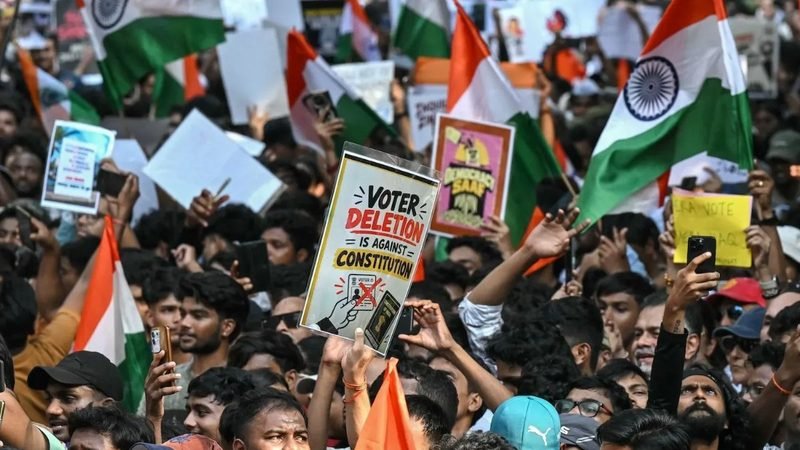
Big protests in New Delhi, aimed at Prime Minister Narendra Modi and the alterations being made to the electoral rolls, have really shook up the political scene. A bunch of people have gone out onto the streets, to say their anger, and well, their frustration too. Mostly, the whole argument circles around what’s happening with the electoral rolls, and the doubts people have about it. Protesters say the updating process shouldn’t be cloudy or half-hidden, it has to be transparent and fair, so that the voting rights of every eligible citizen is not harmed. At the same time, this whole situation has popped back up and sparked a wider national conversation, about how elections work, about democratic rights, and also about political responsibility.
Large-scale protests in New Delhi
The coming together of a big number of people in New Delhi kind of shows, the political importance of this matter. Protesters have spoken out about their displeasure not just with the tweaks to the electoral rolls, but also with Prime Minister Narendra Modi, in a pretty direct way. This kind of protest gives citizens in a democracy a chance to say what they think, because when doubts show up around government stuff or electoral mechanisms, people tend to push these worries out into the public square, so everyone can see them.
Changes to electoral rolls as the central issue
One of the most critical parts of these protests is the modification, or the rewriting, of the electoral rolls. In a sense the electoral roll is the groundwork of any election it kind of acts as the base material, where citizens can actually cast their votes. The protesters are worried that, while the roll is being reviewed and revised, the names of eligible voters could get accidentally taken out. They insist the whole procedure, needs to be clear, and also fully accountable , so people keep trusting the electoral system, because without that it feels unsteady.
Discontent directed at Prime Minister Narendra Modi
Prime Minister Narendra Modi has also been kinda a main focus of the protests, at least for many people watching from the sidelines. In this kind of political dissent, protesters are basically saying they do not agree with the policies and the decisions made by the central government. That kind of public unrest is often seen as part of the wider political scene in the country , you know the overall landscape. But if someone wants to really understand any allegations or political talk, then it is necessary to look at the viewpoints from all sides involved. And not only that, you also need to check the facts that are actually available, before making a conclusion.
Questions Raised Regarding Democratic Rights
Voting is a democratic right, of every eligible citizen. I mean it just feels normal, that people get worried when there are any changes made to the electoral roll. Protesters demand that every citizen gets the same kind of access within the electoral process, and that nobody is deprived of their rights, like fully taken away. Also, this isn’t something that only political parties care about, it spills over into the everyday lives of ordinary citizens too.
Intensifying Debate on the Transparency of the Electoral Process
The opposition around revisions to the electoral roll has put the transparency of the voting process into sharper focus, kind of like people are suddenly seeing it more clearly. In any democratic system it is essential that the procedures for preparing and amending the electoral roll are clear, not hidden in a corner. Citizens should be informed about the rules that guide additions , removals, or correction of names. Transparency is key, it strengthens public trust in the electoral system, it also helps reduce confusion.
Heightened Activity in the Political Sphere
The protests in New Delhi have sorta shaken up the political landscape, and yes the whole picture feels a bit fuzzy now. The actions of the Modi government, plus the questions around changes to the electoral roll or electoral list, have ended up being, like, a main topic in political talk. Since the opposition parties , and the ruling party might see things very differently on something like this it’s important to look at what all stakeholders are saying, and to check the official info too so you can really get what is going on.
Concerns of Ordinary Voters Become a Subject of Discussion
The biggest part of this whole controversy i guess is the regular voter. People want their names to be recorded right on the electoral roll, so they dont get stuck later when it is time to vote. This is super important for first-time , younger voters and also for others who are trying to use their right to vote. If there are mistakes on the electoral roll they need fixing quickly.
All Eyes on the Role of the Election Commission
The Election Commission kind of plays a big role when it comes to the electoral roll. It is, basically, the Commission’s responsibility to see that the established rules are followed so that the electoral roll stays accurate , current and reliable. In the middle of all those controversies there’s also this sort of expectation that the information about the relevant procedures should be put out publicly, and that any grievances , or complaints, get dealt with in the right way. In practice it helps keep public trust in the electoral system.
Protests Introduce a New Issue into National Politics
The protests in New Delhi about changes to the electoral roll might come up as a big deal, in national politics. Various political parties may try to put the whole thing in a larger spotlight by talking about democratic rights and electoral fairness, sort of. But instead of taking every political claim as the final absolute truth, we should look at it in a more grounded way , using facts, official statements, and the evidence that is actually available. Also, the public needs to stay on the main questions despite all the political noise that keeps going back and forth.
The Importance of the Public Voice in a Democracy
The demonstrations in New Delhi about alterations to the electoral roll could end up becoming some big talking point in national politics, at least that’s what people are already saying. Political parties might present the whole thing as “democratic rights” stuff and “electoral fairness” too, like a kind of fairness narrative or whatnot. But, rather than taking every political statement as the absolute truth, people really ought to check what’s actually happening, using facts, official statements, and the evidence that’s there. Otherwise it’s easy for everyone, including the public, to get pulled into all the partisan noise and miss the core issues, while the debate goes on.
The Importance of the Public Voice in a Democracy
The greatest strength of a democracy is probably how people get to participate in public, like for real. Peaceful protests give citizens a chance to show their disagreement and worries, in a calm way. The big turnout in New Delhi, and the questions that came up about changes to the electoral roll, kind of reminds everyone that public faith in the electoral system is absolutely vital. And yeah it’s also on the government, the Election Commission, and political parties to take citizens’ concerns seriously, then answer them in a clear, transparent manner, not with some vague response or delay.
Conclusion
The significant protests in New Delhi—involving Prime Minister Narendra Modi and the issue of changes to the electoral roll—have brought the debate on electoral transparency, democratic rights, and political accountability back to the forefront. The electoral roll serves as a critical cornerstone for any election, and maintaining its integrity and fairness is of utmost importance. It remains to be seen how the relevant authorities and political stakeholders will respond to these concerns. Ultimately, the strength of a democracy depends on ensuring that every eligible citizen has the opportunity to exercise their right to vote, free from any form of discrimination.