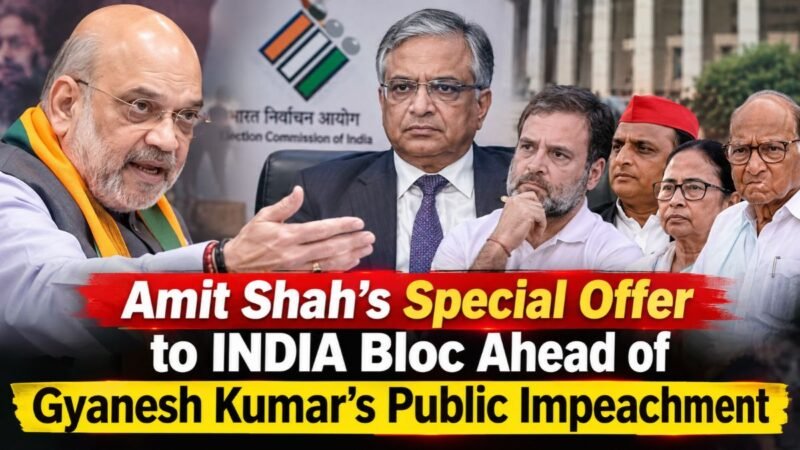
Indian politics right now seems to be getting, a lot more loud, with rhetoric and political action coming in waves. Union Home Minister Amit Shah’s alleged “special offer” to the INDIA bloc, along with public calls for the impeachment of Chief Election Commissioner Gyanesh Kumar, has, more or less, shifted the tone of the whole debate. Because of that, the usual friction between the ruling side and the opposition has turned sharper than before.
The INDIA bloc has been, repeatedly, pushing back against the central government on different matters, while the BJP stays quite active—almost on cue—in countering accusations and the opposition’s methods. In this setting, Shah’s alleged offer, and the questions raised around Gyanesh Kumar, have really fed a lot of talk in political circles. Still, before taking any such pitch or remark as if it’s a confirmed, nailed down fact, it’s better to look carefully at the official backdrop and also the actual ground situation, as it stands.
Why has Amit Shah’s “special offer” sparked political debate?
Amit Shah’s alleged “special offer” to the INDIA bloc is seen as kinda important, like a real political signal, in the arena. In Indian politics, talk not just dialogue — but the whole back and forth, with consensus and disagreement in tow — matters a lot, people notice it. So when one particular offer is dangled in front of the opposition over a big political question, it almost always makes everyone wonder about the deeper political plan and what comes next. That’s basically why these reports, even if they feel slightly routine, end up becoming the main point of chatter and debate.
All eyes on the role of the INDIA block
The INDIA bloc is, sort of, an alliance of several main opposition parties aimed at showing a solid political alternative to the BJP and also the NDA. The big problem for this coalition is not just one thing, but kind of how to square up diverse political ideologies and the regional interests, all together. So in this setting, any special offer from Amit Shah could carry real political weight for the opposition alliance, even if it seems small at first. Still, in the end the actual position of the INDIA bloc will only become obvious after official statements come out from its leadership.
Why has the issue concerning Gyanesh Kumar become a subject of debate?
The inclusion of Chief Election Commissioner Gyanesh Kumar’s name in this political discourse has added a layer of heightened sensitivity to the matter. The Election Commission is a vital constitutional institution within Indian democracy, tasked with making sure elections are genuinely free and fair. So, any controversy that touches the Chief Election Commissioner is not limited to political parties only it also triggers a wider conversation on the democratic system and the election process itself.
Questions Raised by Demands for a Public Impeachment
The rise of calls for a “public impeachment” of Gyanesh Kumar sort of brings up questions about how constitutional processes work and also how political accountability should really be measured. But the procedure for removing the Chief Election Commissioner from office i s not like a normal political impeachment, not really. Under Article 324(5) of the Constitution, the Chief Election Commissioner can be removed from office only in the same manner and on the same grounds, just like a judge of the Supreme Court. So if people are pushing for something like this, then it has to be understood within the boundaries of the constitutional rules, and not outside of them.
Escalating Political Tensions Between the BJP and the Opposition
A political rivalry has long persist in between the BJP and the ‘INDIA’ bloc. From the floor of Parliament , to election rallies too , both sides often challenge each other’s policies, and decisions, in kind of a back and forth way. Matters like the Election Commission role, the independence of democratic institutions, and political transparency have also showed up in this ongoing talk. Amit Shah’s alleged offer, could become a point of discussion within this wider political weather , and people will likely read it through that context.
The Debate Over the Election Commission’s Impartiality
In a democracy, the impartiality of the Election Commission is seen as paramount, and it kind of has to stay that way. While it is natural for political parties to have differing views on the electoral process, those disputes should be handled by putting facts ahead, and using evidence, plus the established constitutional procedure(s) too. An impartial investigation, and then a proper official clarification about any allegations, or controversies involving the Chief Election Commissioner could offer more clarity to the whole political conversation.
The Political Challenge Before the Opposition
For the ‘INDIA’ bloc, this situation carries both political and strategic weight, kind of. The opposition has to keep its alliance together, on one hand, and at the same time be able to voice a clean position about national matters on the other. If an official answer shows up regarding Amit Shah’s alleged proposal, it might give a window into what the opposition’s coming political approach, will be.
Discussion on Amit Shah’s Political Strategy
Amit Shah is often seen as one of the key strategic leaders in the BJP. His political remarks and choices get judged in a wider political frame, not just as stand alone comments. Because of this, people have been focusing on an alleged “special offer” that is said to have been made to the INDIA bloc, and it has gotten a lot of attention. Still, instead of jumping to conclusions about what was meant behind any such move, it might make more sense to look at what was actually said, and the circumstances that were around it, at that moment, in full.
The Importance of Democracy and Constitutional Institutions
Honestly the most critical thing in this whole sequence, is the credibility of Indian democracy and its constitutional institutions. While disagreements between political parties are a normal part of democracy, it’s also equally important to keep the independence and wholeness of institutions like the Election Commission, like really. If there is any dispute then it should be worked through according to constitutional norms transparency and facts, not whatever rhetoric. In that way the confidence of the general public in the democratic system stays intact, and nothing feels shaky.
What Lies Ahead? All Eyes on Political Developments
The direction in which the alleged “special offer” from Amit Shah, and the talk of a public impeachment of Gyanesh Kumar might veer is going to depend on the official words of the leaders involved, and also on the established constitutional process. Political analysts, and honestly most of the public are going to keep a close watch on what the INDIA bloc does next, how the BJP reacts, and whether any official information shows up from the Election Commission.
For now though, what seems clear is this that both dialogue and confrontation between the ruling party, and the opposition can play a big role in Indian politics, really. In all of this, it becomes important that verified facts and constitutional decorum are put first over political assertions.