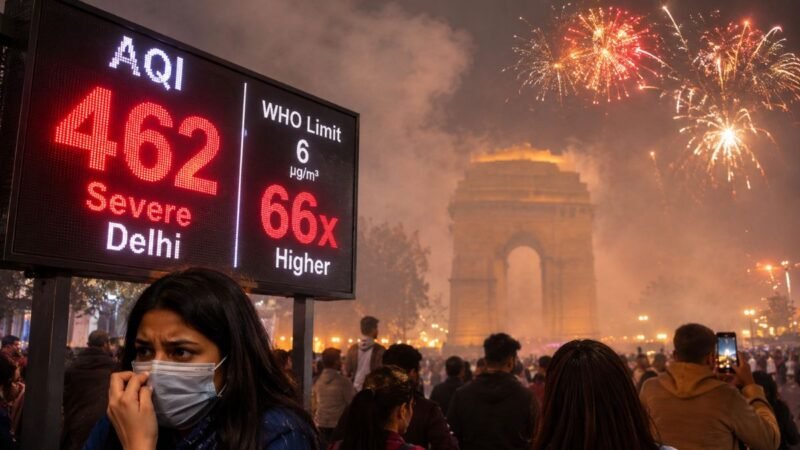
While the festival of Diwali was celebrated in Delhi with light, joy, and enthusiasm, the air quality in the capital following the festival has become a cause for serious concern. Despite a ban on firecrackers, people in many areas engaged in extensive bursting of fireworks, which took a toll on Delhi’s air quality. In some regions, air pollution levels were recorded at up to 66 times the safe limit prescribed by the World Health Organization (WHO). This situation is not only hazardous to the environment but also poses a major threat to the health of the millions of people living in Delhi. The problem of rising air pollution around Diwali recurs every year; however, even this time—despite restrictions and awareness campaigns—there has been no significant improvement in the situation.
Surge in air pollution in Delhi after Diwali
Following the Diwali festival, air quality in many parts of Delhi deteriorated severely. Smoke from fireworks and firecrackers set off during the night polluted the atmosphere. By morning, the concentration of harmful particulate matter in the air had risen in several areas, causing people to experience difficulty in breathing. This level of pollution is particularly concerning for children, the elderly, and those already suffering from respiratory issues.
Pollution levels up to 66 times the WHO safe limit
The most alarming aspect of this situation is that, in some parts of Delhi, air pollution levels reached up to 66 times the safe limit set by the WHO. The World Health Organization considers fine particulate matter in the air to be a serious health hazard. When the concentration of these particles exceeds normal levels by many times, it directly impacts human lungs and the respiratory system. Prolonged exposure to such pollution can lead to various serious health complications.
Extensive use of firecrackers despite the ban
A ban on firecrackers had been imposed in Delhi in an effort to control air pollution. The administration had appealed to the public to follow the rules and celebrate an eco-friendly Diwali. Despite this, in many places, people ignored the restrictions and burst firecrackers. A thick layer of smoke was visible in the sky due to the fireworks that continued throughout the night. This incident demonstrates once again that merely establishing rules is not enough; ensuring their enforcement and securing the cooperation of citizens is equally crucial.
Smoke from firecrackers: A major cause of pollution
Bursting firecrackers releases various harmful gases and fine particulate matter into the atmosphere. These include pollutants like PM2.5 and PM10, which can enter the human body through the air. The extremely fine particles of PM2.5 are capable of reaching deep into the lungs. Furthermore, the smoke from firecrackers can cause issues such as eye irritation, a sore throat, coughing, and breathing difficulties. When this smoke mixes with the already polluted air of Delhi, the situation becomes even more severe.
Increased health risks for children and the elderly
Rising air pollution can have the most significant impact on children and the elderly. Since children’s lungs are still developing, polluted air can have long-term effects on their health. Meanwhile, the elderly may face breathing difficulties, coughing, and other physical ailments. For those suffering from asthma or heart-related conditions, venturing out in such air can be particularly risky. During such times, families should take extra care of the health of their children and elderly members.
Delhi’s already poor air quality exacerbates the challenges
Air pollution in Delhi is not solely caused by Diwali; several other factors contribute to it during the winter season. Emissions from vehicles, dust from construction activities, industrial discharge, and the burning of crop stubble in surrounding areas also drive up pollution levels. During winter, low wind speeds and specific meteorological conditions can cause pollutants to persist in the atmosphere for extended periods. In such a scenario, the use of fireworks during Diwali can further exacerbate an already poor situation.
Questions Raised Regarding Administrative Bans and Awareness Campaigns
The administration often makes various efforts to impose bans on firecrackers and raise public awareness. However, the large-scale use of fireworks despite these bans raises questions about the effective enforcement of regulations. Simply issuing government orders will not resolve the problem of pollution. It requires strengthening monitoring systems, taking appropriate action against those who violate the rules, and educating the public about the harmful effects of pollution. Both the administration and citizens must work together to find a solution to this issue.
Impact of Polluted Air on Daily Life
Poor air quality is not limited to health concerns alone; it also affects people’s daily lives. Activities such as morning walks, playing in open fields, or exercising outdoors can become difficult. Many individuals may experience eye irritation, headaches, and breathing difficulties. When pollution levels rise, it may also become necessary to restrict children’s outdoor activities. Furthermore, a thick layer of haze and smoke in the atmosphere can impair visibility.
The Responsibility of Citizens in Reducing Pollution
Reducing pollution in Delhi is not solely the government’s responsibility; every citizen must also play their part. People should avoid using banned firecrackers and celebrate festivals in an environmentally friendly manner. Small steps—such as reducing the use of private vehicles, opting for public transport, refraining from burning waste, and protecting trees and plants—can prove highly effective. Most importantly, while celebrating, one must remain mindful of the health of others and the well-being of the environment.
The Joy of Festivals Is Incomplete Without Clean Air
Diwali is a festival of joy, love, and spending time with one another. However, if people are forced to breathe toxic air in the aftermath of these celebrations, the joy of the festival is inevitably diminished. In Delhi, pollution levels reaching up to 66 times the safety limit set by the WHO serve as a grave warning that cannot be ignored. Moving forward, the government, the administration, and the public must work together to adopt measures that allow for festive celebrations without causing harm to the environment. Ultimately, the ‘festival of lights’ will only be truly successful when every individual has the opportunity to live in an environment with clean air and a healthy atmosphere