
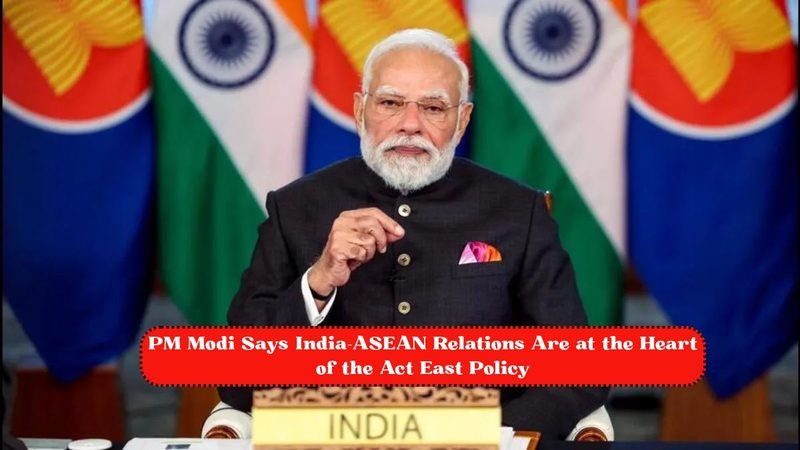
Relations between India and the Association of Southeast Asian Nations (ASEAN) have steadily strengthened over the past few years. Highlighting the significance of the India-ASEAN partnership, Prime Minister Narendra Modi has stated that strong ties with ASEAN lie at the core of India’s ‘Act East Policy.’ Southeast Asia holds a special place in India’s foreign policy, and fostering cooperation with ASEAN nations is among India’s key priorities. Collaboration between India and ASEAN continues to advance across various sectors, including trade, investment, security, technology, culture, and regional connectivity.
PM Modi’s significant statement on India-ASEAN relations
Prime Minister Narendra Modi has described the deepening ties between India and ASEAN nations as a vital component of India’s foreign policy. According to him, India’s partnership with ASEAN extends beyond mere diplomatic relations; it is also crucial for the economic development, peace, and stability of both regions. For a long time, India has been working to strengthen its historical, cultural, and commercial links with Southeast Asian nations. PM Modi’s statement reflects India’s intent to elevate its cooperation with ASEAN to new heights in the future.
What is India’s ‘Act East Policy’?
The ‘Act East Policy’ is a significant initiative within India’s foreign policy, aimed at strengthening political, economic, and strategic ties with countries in Southeast and East Asia. In 2014, India evolved its earlier ‘Look East Policy’ into the ‘Act East Policy.’ This policy emphasizes not only enhancing dialogue and diplomatic engagement but also fostering practical cooperation, trade, investment, infrastructure development, and regional connectivity. ASEAN serves as a cornerstone of this entire strategy, as Southeast Asia represents a major hub for regional cooperation and economic opportunities for India.
Historical and Cultural Ties between India and ASEAN
The relationship between India and ASEAN nations is not a recent development; its roots go back centuries. India has long maintained deep connections with several Southeast Asian countries through trade, religion, language, art, and culture. Traces of Indian culture can still be seen today in countries such as Indonesia, Thailand, Cambodia, Vietnam, and Malaysia. The influence of Indian epic traditions, like the Ramayana and the Mahabharata, is also evident in the cultural heritage of this region. This historical and cultural bond plays a crucial role in strengthening trust between the two sides.
Prospects for Growing Cooperation in Trade and Investment
The economic partnership between India and ASEAN is highly significant for both regions. There is continuous potential for the expansion of trade cooperation between India and ASEAN nations. New opportunities exist for both sides in sectors such as electronics, pharmaceuticals, agriculture, automobiles, digital services, textiles, and manufacturing. India seeks better access for its businesses and industries to markets in Southeast Asia. Meanwhile, ASEAN nations also value India’s vast consumer market and its investment opportunities. Stronger trade relations can benefit both economies while fostering employment and industrial growth.
Special Focus on Regional Security and Maritime Cooperation
Regional security is a vital aspect of the partnership between India and ASEAN. The maritime routes connecting the Indian Ocean and the Pacific Ocean are of critical importance to global trade. Consequently, cooperation on issues such as maritime security, counter-terrorism, cybersecurity, and organized crime has become essential. India and ASEAN nations prioritize peace, stability, and respect for international rules within the region. Through maritime exercises, security dialogues, and defense cooperation, both sides are working toward enhancing mutual trust.
Connectivity Projects to Strengthen Mutual Relations
Connectivity is accorded special importance within India’s ‘Act East’ policy. Improving road, rail, maritime, and air connectivity between India and Southeast Asia can facilitate trade and the movement of people. Projects such as the India-Myanmar-Thailand Trilateral Highway are considered significant in this regard. The completion of these projects could help connect India’s northeastern states with Southeast Asian markets. Enhanced connectivity is also expected to provide fresh impetus to tourism, investment, trade, and cultural exchange.
New Opportunities for Partnership in Digital Technology and Innovation
In the contemporary era, digital technology has become a vital foundation for any nation’s economic progress. India has made remarkable strides in areas such as digital payments, information technology, and digital public infrastructure. Sharing these experiences with ASEAN nations can foster digital cooperation. There is immense potential for joint initiatives in sectors like fintech, artificial intelligence, cybersecurity, startups, and digital education. A technological partnership between India and ASEAN could steer regional development and innovation in a new direction in the future.
Potential for Boosting Youth, Education, and Tourism
In the contemporary era, digital technology has become a vital foundation for the economic progress of any nation. India has made remarkable strides in the realms of digital payments, information technology, and digital public infrastructure. Sharing these experiences with ASEAN nations can foster greater digital cooperation. There is immense potential for joint initiatives in sectors such as fintech, artificial intelligence, cybersecurity, startups, and digital education. A technological partnership between India and ASEAN could provide a new direction for regional development and innovation in the futurePotential for Boosting Youth, Education, and Tourism
Challenges Facing India and ASEAN
Despite the strength of the India-ASEAN relationship, certain challenges persist. Regional geopolitical tensions, trade imbalances, issues related to cross-border connectivity, and global economic uncertainties can impact cooperation between the two sides. Additionally, the timely completion of various infrastructure projects remains a significant challenge. Addressing these issues requires sustained dialogue, mutual trust, and practical cooperation. India remains committed to strengthening its partnership with ASEAN—despite these challenges—and advancing shared goals of regional stability and development.
High Hopes for the Future through the India-ASEAN Partnership
The relationship between India and ASEAN has the potential to shape the economic and strategic trajectory of Asia in the years to come. Prime Minister Narendra Modi’s emphasis on placing ASEAN at the core of the ‘Act East Policy’ underscores the significance of this partnership. For India, ASEAN is not merely a trading partner but a vital ally in fostering regional peace, security, and development. Enhanced connectivity, robust trade, technological collaboration, and cultural exchange between the two sides hold the potential to unlock new opportunities. Should India and ASEAN continue to work in tandem on their shared priorities, this partnership could prove beneficial not only for both regions but for the entire Asia-Pacific.
Conclusion:
The strengthening ties between India and ASEAN are providing a new direction to India’s ‘Act East Policy.’ PM Modi’s statement highlights the pivotal role that Southeast Asia occupies within India’s foreign policy. In the times ahead, this partnership is expected to grow even stronger through cooperation in trade, security, technology, and cultural spheres.