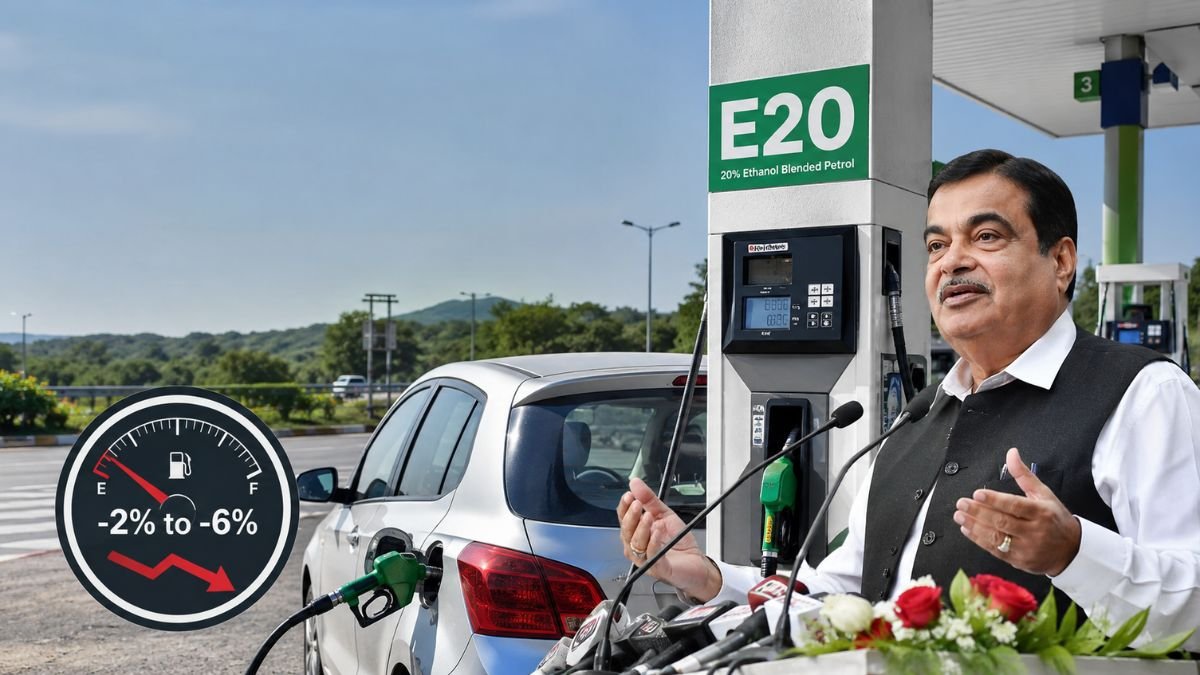
The government is continuously working to increase the ethanol content in petrol in India. As part of this initiative, E20 petrol is being rolled out across the country in a phased manner. Recently, Union Minister for Road Transport and Highways Nitin Gadkari stated that the use of E20 petrol could reduce the fuel economy of certain vehicles by 2% to 6%.
However, he also clarified that, despite this, E20 represents a significant step for the country in terms of environmental sustainability and energy security. If you are interested in learning more about E20 petrol—including its mileage, advantages, and disadvantages—this quick review will answer all your questions.
What is E20 petrol?
E20 petrol is a fuel blend consisting of 20% ethanol and 80% regular petrol. Ethanol is a biofuel primarily produced from sugarcane, maize, and other agricultural products. The objective is to reduce India’s dependence on petroleum and promote the use of cleaner fuel.
The government believes that ethanol-blended fuel will reduce expenditure on imported crude oil and provide farmers with an additional source of income.
What did Nitin Gadkari say?
According to Nitin Gadkari, the use of E20 petrol can lead to a 2% to 6% reduction in the fuel economy of certain vehicles. This means that if a vehicle previously delivered a mileage of 20 kilometers per liter, the same vehicle might deliver approximately 18.8 to 19.6 kilometers per liter when using E20 petrol.
However, this impact will not be uniform across all vehicles; factors such as the vehicle’s engine, its technology, and the manufacturer’s E20 compatibility specifications influence this variation.
Why does fuel economy decrease?
Ethanol has a slightly lower energy content compared to regular petrol. Consequently, the engine may require slightly more fuel to cover the same distance. This is why a slight drop in mileage might be observed when using E20 petrol. However, modern engines are being designed to handle this change more effectively.
Will this affect all vehicles?
No. The impact of E20 will not be the same for all vehicles. Many new-generation cars and bikes are already being manufactured to be E20-compatible. In such vehicles, the difference in mileage may be negligible
Conversely, older vehicle models might show a slightly more noticeable difference in mileage. Therefore, it is essential to follow the guidelines issued by the vehicle manufacturer.
Key benefits of E20 petrol
Despite a potential slight reduction in mileage, E20 petrol offers several significant benefits:
- It helps reduce pollution.
- It decreases dependence on petroleum imports.
- It contributes to increasing farmers’ income.
- It boosts the biofuel industry in the country.
- It aids in reducing carbon emissions.
- For these reasons, the government is promoting it as the fuel of the future.
Is E20 petrol safe for the engine?
If your vehicle is E20-compatible, using it is considered safe under normal conditions. Many automobile companies are now developing engines capable of performing well with E20 fuel.
However, owners of older vehicles should verify—either through their vehicle manual or an authorized service center—whether their model is suitable for E20.
Will the drop in mileage lead to higher costs?
This question arises in the minds of most vehicle owners. If a vehicle’s fuel economy drops by 2% to 6%, it will certainly consume slightly more fuel to cover the same distance.
On the other hand, the government aims to control fuel costs and strengthen the country’s energy security by increasing ethanol production. Its actual economic impact will be determined in the future based on prices and availability.
Why is E20 important for India?
India meets a significant portion of its energy needs through crude oil imports, resulting in a massive outflow of foreign exchange. Initiatives like E20 steer the country towards alternative fuels and help reduce dependence on imported oil.
Furthermore, increased participation of the agricultural sector in ethanol production can strengthen the rural economy. This is why the government views it as part of its long-term strategy.
What should vehicle owners keep in mind?
If you are considering using E20 petrol, first ensure that your vehicle is E20-compatible. Service your vehicle regularly and keep an eye on the engine’s condition.
There is no need to panic if you notice a slight change in mileage. Fuel economy can be effectively maintained by ensuring correct tire pressure, regular servicing, and a balanced driving style.
Conclusion: Is adopting E20 petrol the right decision?
E20 petrol represents a significant step towards a clean and sustainable energy future for India. While the 2% to 6% drop in fuel economy mentioned by Nitin Gadkari is certainly important information for vehicle owners, it should not be viewed merely as a drawback.
If your vehicle is suitable for E20, using it contributes to major national goals such as environmental conservation, energy self-reliance, and boosting farmers’ income. As automobile companies develop fully E20-compatible engines in the coming years, concerns regarding mileage are likely to diminish.