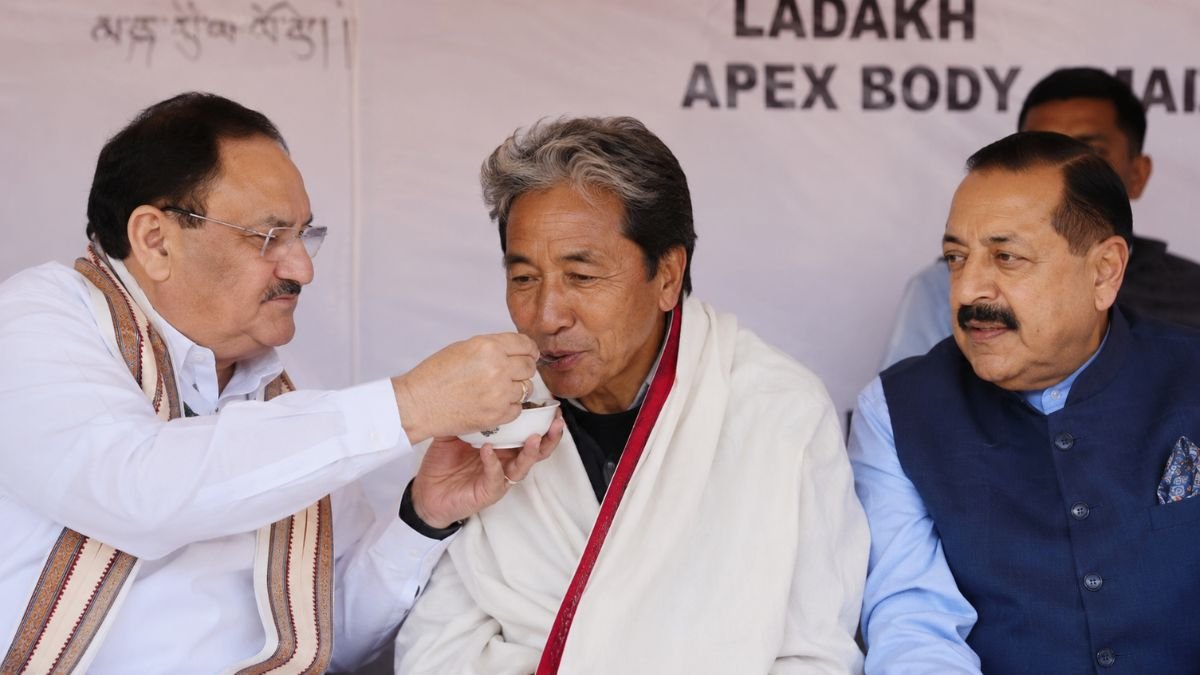
Sonam Wangchuk, a social activist, engineer, and education reformer from Ladakh, ended his 26-day-long hunger strike in the presence of Union Health Minister J.P. Nadda and Union Minister Dr. Jitendra Singh. This prolonged movement captured the attention of the entire nation.
Wangchuk maintained that his objective was not to seek political gain but to safeguard Ladakh’s environment, culture, and the rights of its local people. The conclusion of his hunger strike has sparked hope that a constructive dialogue between the government and the agitators will now move forward.
Why was this hunger strike initiated?
Sonam Wangchuk began his hunger strike to address several critical issues concerning Ladakh. His primary aim was to raise national awareness regarding the region’s environmental conservation, employment opportunities for local youth, the protection of natural resources, and demands for constitutional rights. He believes that the Himalayan region is highly sensitive and that maintaining an ecological balance alongside development is equally essential. Driven by this conviction, he sought to convey his message to the government through peaceful means.
A peaceful movement spanning 26 days
Throughout the 26-day hunger strike, Sonam Wangchuk steadfastly adhered to the principles of non-violence and democratic protest. People from across the country extended their support via social media and various other platforms. Numerous social organizations, environmental experts, and students also demonstrated their solidarity with the movement. Although health concerns arose during this period, Wangchuk remained resolute in his mission.
Why was the presence of J.P. Nadda and Jitendra Singh significant?
The presence of Union Ministers J.P. Nadda and Dr. Jitendra Singh at the conclusion of the hunger strike is considered highly significant. It signaled that the central government is viewing the issue seriously and is willing to seek a resolution through dialogue. The presence of both leaders helped build trust among the agitators and conveyed the message that the government is committed to the path of dialogue.
A Fresh Start to Dialogue Between the Government and Protesters
With the conclusion of the hunger strike, the path for dialogue between the government and representatives of the movement has been strengthened. Dialogue is considered the most effective solution to any dispute in a democracy. If both sides move forward with a positive mindset, solutions can be found for several long-standing issues concerning Ladakh. This step could prove significant for fostering better cooperation in the future.
Renewed Focus on Environmental Conservation in Ladakh
Sonam Wangchuk has long been working on issues such as Himalayan ecology and climate change. He believes that unchecked development in Ladakh could lead to serious environmental challenges in the future. Following his movement, topics like environmental conservation, the protection of glaciers, and sustainable development have once again become part of the national discourse. Experts also agree on a distinct development model. Experts also concur that Himalayan regions require a unique development model. for Himalayan regions.
Heightened Hopes Among Local Residents
Following the end of the hunger strike, optimism has grown among the local people of Ladakh that their demands will now be taken seriously. There is a belief that if regular dialogue continues between the government and local representatives, positive decisions could emerge regarding issues such as employment, education, infrastructure, and environmental conservation. The movement succeeded in bringing the voice of the local population to the national stage.
Widespread Response Across the Country
Sonam Wangchuk’s hunger strike People across the country did not view Sonam Wangchuk’s hunger strike as limited to Ladakh alone. Social organizations, academicians, environmental activists, and youth from across the country expressed their views on the movement. The issue remained a constant topic of discussion on social media as well. Many described it as a significant movement linked to environmental and democratic rights, while some experts regarded dialogue between the government and the protesters as the best way forward.
What Was the Message of the Movement?
The entire movement conveyed the message that in a democracy, one can effectively voice one’s views through peaceful and constitutional means. Sonam Wangchuk consistently emphasized the importance of dialogue, non-violence, and public participation. Their objective was not to create a confrontational situation, but rather to draw the government’s attention to issues they have long considered significant. This is precisely why their movement garnered widespread public support.
What challenges lie ahead for the government?
The primary responsibility now rests with the government to take concrete steps regarding the issues raised during the dialogue. If time-bound decisions are made concerning environmental conservation, local development, employment, and administrative reforms, public trust will be further strengthened. Experts believe that formulating and implementing an effective action plan on these issues is far more important than merely offering assurances.
Conclusion: End of the hunger strike, but a new beginning for hopes
The conclusion of Sonam Wangchuk’s 26-day hunger strike marks not just the end of a movement but potentially the start of a new phase of dialogue and resolution. The presence of Union Ministers J.P. Nadda and Dr. Jitendra Singh added significant weight to these developments. All eyes across the country will now be on how the government and the stakeholders involved in the movement collaborate to take concrete measures for Ladakh’s development, environmental conservation, and the welfare of the local people.