
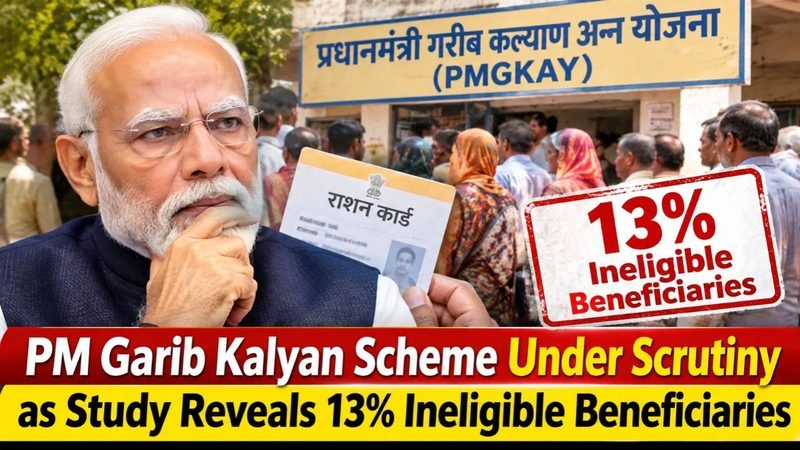
Pradhan Mantri Garib Kalyan Anna Yojana (PMGKAY) is an important scheme of the Government of India to provide food security to poor and needy families. The main objective of this scheme is to provide free ration to the economically weaker families, so that no poor family faces shortage of food. However, a recently published study has raised new questions regarding the eligibility of the beneficiaries of this scheme. According to the study, about 13 percent of the beneficiaries of the scheme have been found who may not be eligible to avail the benefits of this scheme as per the prescribed eligibility criteria. After this revelation, the discussion has intensified regarding extending the benefits of government schemes to the right people and checking their eligibility.
Why is PM Garib Kalyan Yojana important?
The objective of Pradhan Mantri Garib Kalyan Anna Yojana is to provide food grains to the poor and needy families of the country. Amidst inflation and economic problems, free ration has proved to be a great relief for millions of families. Through this scheme the government tries to ensure food security and provide assistance to the weaker economic sections. This scheme is considered very important especially for rural areas and low income families.
13 percent error revealed in the study
In a recent study, information related to the beneficiaries of the scheme was analyzed, in which about 13 percent inclusion error has come to light. This means that some people are also taking advantage of the scheme, who should not be eligible as per the eligibility conditions. Such irregularities raise questions about the proper use of government resources.
Questions raised on families owning cars
The study also mentions beneficiaries who own assets like cars. Generally, government food assistance schemes are aimed at helping economically vulnerable families. In such a situation, the inclusion of car-owning families in the free ration scheme raises questions regarding the eligibility check. However, it would not be appropriate to declare a family ineligible merely on the basis of having a car, as the actual economic situation and the official rules of the scheme are also important.
Concern about those doing government jobs
The issue of some beneficiaries related to government jobs has also come to light in this study. Government employees get regular salary and other facilities, so it is natural to raise questions on their eligibility in the scheme. If such families are receiving free ration despite the prescribed rules, then it shows the need to improve the system.
What does Inclusion Error mean?
Inclusion Error means inclusion of people in a government scheme who are not actually eligible for it. On the other hand, Exclusion Error occurs when needy and eligible families are deprived of the benefits of the scheme. For the success of any welfare scheme, it is important to reduce both these types of mistakes, so that government assistance can reach the right beneficiaries.
Potential impact on families in genuine need
If ineligible individuals continue to avail themselves of the scheme’s benefits, it could negatively affect families who are truly in need. Government resources are limited, and their optimal utilization is crucial. Therefore, maintaining transparency and accuracy in the identification of beneficiaries is essential. This will help ensure that food assistance intended for poor families does not fall into the wrong hands.
Necessity of verifying ration card eligibility
To enhance transparency within the scheme, it is important to periodically verify the information of ration card holders. Data regarding a family’s income, assets, and other eligibility criteria can be cross-referenced with official government records. However, care must be taken during this process to ensure that the ration cards of families who are genuinely in need are not cancelled by mistake.
Challenges faced by the government
The primary challenge for the government lies in identifying ineligible beneficiaries while simultaneously ensuring that poor families are not inadvertently excluded from the scheme. Rather than making decisions based solely on assets or employment status, it is necessary to consider a family’s actual economic condition alongside official eligibility guidelines. Furthermore, it is essential to improve data sharing between government departments and strengthen grievance redressal mechanisms.
The role of digital verification
Utilizing digital records, Aadhaar-based authentication, and technology within the ration distribution system can help streamline beneficiary data. This makes it easier to identify incorrect information and fraudulent beneficiaries. Nevertheless, no poor family should be deprived of their rations due to technical glitches or a lack of documentation. Consequently, a robust system for handling complaints and appeals must accompany the verification process.
Ensuring transparency and reaching the intended beneficiaries
The core objective of the ‘PM Garib Kalyan Yojana’ is to provide food security to the nation’s needy families. In this context, the 13 percent ‘inclusion error’ identified in the study underscores the urgent need to strengthen the scheme’s monitoring and eligibility verification systems. It is essential for the government to identify ineligible beneficiaries in an impartial manner, ensuring that the assistance intended for genuinely poor families remains unaffected under any circumstances. Ultimately, the true success of any government welfare scheme is measured by whether its benefits reach the right individuals and whether families in need continue to receive what is rightfully theirs.