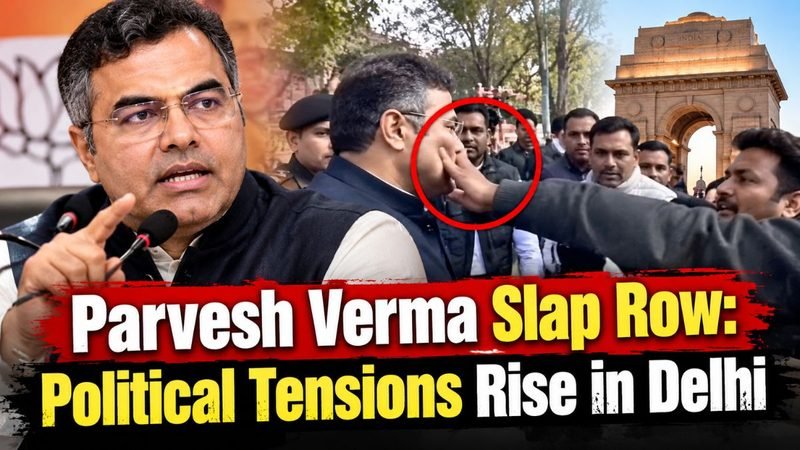
Delhi politics has entered another heated phase after a road-inspection incident involving Public Works Department (PWD) Minister and BJP leader Parvesh Verma. A video showing Verma appearing to slap a man during an inspection in West Delhi’s Vikaspuri/Tilak Nagar area quickly circulated on social media, triggering sharp reactions from the Aam Aadmi Party (AAP), Congress, and BJP. The controversy has since expanded beyond the confrontation itself, with competing allegations about road quality, the conduct of people present at the site, and complaints made to police.
How the Parvesh Verma Incident Began
The controversy began during an inspection of a newly constructed road in west Delhi. Reports say Verma was at the site to examine the road work when a confrontation developed involving people associated with AAP MLA Jarnail Singh. Videos circulated online showing a heated exchange followed by Verma pushing down a man’s mobile phone and appearing to slap him. The footage rapidly became the center of the political controversy.
The incident attracted attention partly because it happened during what was supposed to be an inspection of public infrastructure. Instead of remaining focused on the road project, the visit ended with a physical confrontation that quickly became a major political story in Delhi.
Road Quality Is at the Center of the Dispute
The original disagreement was reportedly connected to the quality of the newly constructed road. AAP MLA Jarnail Singh questioned the condition of the road and, according to reports, demonstrated concerns about the road surface during the inspection. The issue therefore quickly moved from a local infrastructure complaint into a broader political confrontation.
Road quality is a particularly visible civic issue in Delhi because residents regularly raise concerns about damaged roads, construction standards, and maintenance. In this case, the condition of the road became the backdrop against which the confrontation occurred, giving both sides a wider political argument to make.
What Parvesh Verma Said About the Incident
Verma has offered his explanation of what happened. He said he had gone to inspect the construction work and claimed that people accompanying Jarnail Singh behaved aggressively and abused his family. According to Verma’s account, he reacted in the heat of the moment after allegedly hearing such remarks. He later acknowledged that the incident should not have occurred.
Verma has also disputed the suggestion that the confrontation was simply about poor road construction. He alleged that Jarnail Singh and people accompanying him were responsible for creating the situation at the site. These are allegations from Verma’s side and remain part of the broader dispute.
AAP’s Version of Events
AAP leaders have presented a different account. Jarnail Singh stated that the road’s quality was under scrutiny and that the man involved in the confrontation was recording the proceedings. Singh rejected allegations that the man had abused Verma or his family.
AAP leaders have used the incident to criticize the BJP-led Delhi government and have demanded action against Verma. Former Delhi chief minister Arvind Kejriwal also reacted publicly, calling for action over the incident. The party has argued that the focus should remain on questions surrounding the road work and the treatment of people who raised those concerns.
The Viral Video Changed the Story
Social media played an important role in turning the local confrontation into a major political controversy. Short videos showing the altercation were widely circulated, allowing people across Delhi and beyond to see portions of the incident. However, individual clips do not necessarily establish everything that happened before or after the recorded moments.
The rapid circulation of the footage also meant that political reactions emerged almost immediately. AAP leaders shared the video while BJP leaders responded with their own explanations of the circumstances. As is common with viral political incidents, different sides have focused on different portions of the available footage.
Complaints Have Been Filed From Both Sides
The dispute has also moved into the formal complaint process. Saheb Singh, the man who was allegedly slapped, submitted a police complaint concerning the incident. He alleged that he was abused and assaulted while questioning the road work. Police have said they received the complaint and were verifying the facts.
At the same time, complaints were reportedly submitted against Jarnail Singh and others by PWD engineers and the contractor. Those complaints alleged obstruction of public work and other conduct connected with the road project. This means the controversy is not limited to political statements; allegations from both sides have entered the police process.
Also Responded to the Controversy
The Delhi BJP has described the incident as unfortunate and expressed regret over what happened. At the same time, the party alleged that the circumstances surrounding the confrontation involved deliberate provocation by the AAP MLA and people accompanying him. The BJP has questioned the conduct of the AAP side and said the circumstances surrounding the incident should also be examined.
This response reflects the larger political battle now developing around the incident. Rather than treating the confrontation as an isolated event, both parties are connecting it to questions about political behavior, public works, and accountability.
Congress Also Entered the Debate
The controversy has not remained limited to the BJP and AAP. Congress leaders also criticized the incident. Rahul Gandhi described the episode as an example of political power being used inappropriately, while Delhi Congress leaders called for public representatives to answer questions through their work and conduct.
The Congress reaction adds another political dimension to an already tense dispute. With multiple parties commenting on the incident, the slap controversy has become part of the wider political conversation in Delhi rather than simply a disagreement at a road-inspection site.
Why the Incident Matters Beyond One Road
The controversy has highlighted two broader issues: the quality of public infrastructure and the behavior expected from elected representatives. Road construction is ultimately a public-service issue, meaning questions about materials, workmanship, contracts, and maintenance can directly affect residents.
At the same time, confrontations involving political leaders can quickly overshadow the original civic issue. In this case, attention that began with a road inspection has largely shifted toward the physical confrontation and the competing allegations surrounding it. The ongoing complaints and verification process may determine which aspects of the allegations can be substantiated.
What Happens Next
The immediate focus is likely to remain on the police complaints, available video evidence, and the competing accounts of the people involved. Police have said that the complaint concerning the alleged assault is being verified, while complaints concerning the road work and alleged obstruction have also been reported.
For Delhi residents, the controversy raises questions that extend beyond party politics: What was the actual condition of the road? What exactly happened before the confrontation? And how should disputes between public representatives and citizens be handled during official inspections? As the investigation and political responses continue, those questions will remain central to the story.
Final Takeaway
The Parvesh Verma slap row has quickly developed from a road-quality dispute into a wider political controversy involving BJP, AAP, and Congress. Verma and AAP representatives have offered conflicting accounts of the confrontation, while complaints have reportedly been filed by people on both sides.
The incident also demonstrates how quickly a local civic issue can become a major political flashpoint when elected representatives, public infrastructure, and viral social media footage collide. The next developments will depend largely on the police verification and any further evidence emerging from the incident.