
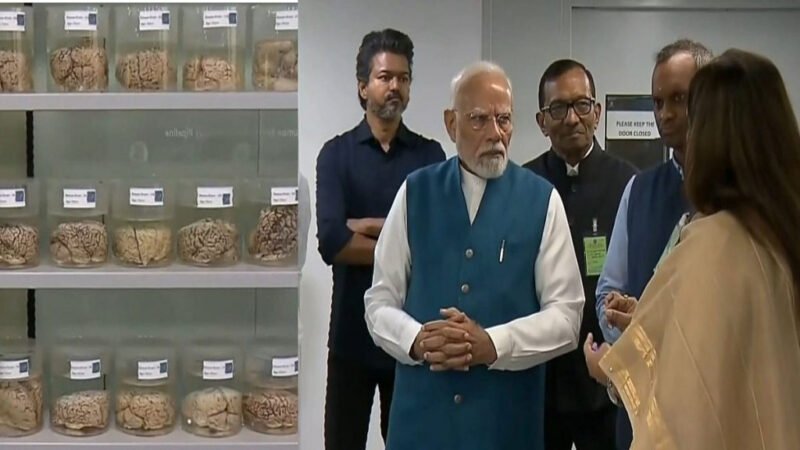
A significant initiative has been launched in India within the fields of science and medical research. The Sudha Gopalakrishnan Brain Centre at the Indian Institute of Technology Madras (IIT Madras) is working on high-resolution digital 3D mapping of the human brain. The objective of this mission is to understand the structure of the human brain down to the cellular level and to study changes associated with different ages and brain-related diseases. In his radio program ‘Mann Ki Baat’ on October 25, 2026, Prime Minister Narendra Modi mentioned this research, highlighting its importance to India’s scientific endeavors.
This project is significant because it could help scientists gain a more detailed understanding of the complex structure of the human brain and the damage caused by conditions such as strokes. However, this does not mean that a computer will now be able to directly read a person’s thoughts. The primary objective of this technology is to create digital 3D images and a scientific atlas of the brain, enabling researchers to study its various components and cells in great detail.
IIT Madras Brain Mapping Research: What is the full mission?
The Sudha Gopalakrishnan Brain Centre (SGBC) at IIT Madras has launched an ambitious scientific mission for the 3D mapping of the human brain. The initiative aims to create 3D atlases—at a cellular resolution—of over 100 human brains, covering the entire lifespan from the embryonic stage to old age. The study will encompass both healthy brains and those affected by diseases.
In this technique, post-mortem human brain samples undergo specialized imaging and computational processes. The resulting data is then used to create a digital 3D model of the brain’s structure. This enables scientists to examine minute structures that cannot be observed with the same level of detail using conventional medical imaging.
The objective of this research is not merely to create images of the brain, but also to understand the relationships between its structure, its cells, and the changes associated with disease. In the future, this information could prove useful for new discoveries in the fields of neuroscience and neuromedicine.
What did PM Modi say? Why is the research from IIT Madras in the spotlight?
Prime Minister Narendra Modi launched the mission of the Sudha Gopalakrishnan Brain Centre at IIT Madras on October 11, 2026. Subsequently, in the 139th episode of ‘Mann Ki Baat’ on October 25, he highlighted the centre’s brain imaging technology and its efforts toward the digital mapping of the human brain. He described this initiative as significant for India’s research capabilities and scientific collaboration.
This project involves collaboration among scientists, engineers, medical institutions, and international researchers. According to IIT Madras, more than 200 researchers, engineers, and technicians from the center are working on this mission. Furthermore, over 10 medical institutions in India and more than 30 leading researchers from over 10 countries are also contributing to this endeavor.
This collaboration demonstrates that understanding complex brain-related problems requires bringing together engineering, computing, medical science, and neuroscience.
3D images of the brain are being generated using a supercomputer of immense power.
One of the most significant technical features of this mission is the use of the ‘Param Shakti’ supercomputer. According to IIT Madras, this computing facility has been used to process large and complex brain-imaging data to create high-resolution digital 3D maps.
The human brain contains billions of nerve cells and complex connections between them. Understanding their structure requires the analysis of vast amounts of imaging data. Supercomputers help process this data, enabling researchers to study the brain’s structure through digital maps.
The digital atlas prepared in this manner has been made available through an online visualization and computing platform. This provides researchers and medical experts across the globe with the opportunity to study scientific information related to the human brain.
What is C-STROKE Atlas, and how can it benefit patients?
Another major achievement associated with this project is C-STROKE, developed by the Sudha Gopalakrishnan Brain Centre at IIT Madras. According to the institute, it is the world’s first atlas of human ischemic stroke. It contains over 1,000 meticulously annotated sections of a human brain affected by a stroke.
An ischemic stroke occurs when blood flow to a part of the brain is blocked or severely reduced. As a result, brain cells are deprived of oxygen and essential nutrients, which can cause them damage.
The C-STROKE atlas helps establish a link between clinical MRI scans and the imaging of the entire brain at a microscopic level. It enables the study of indicators such as neuronal health, neuroinflammation, disruption of the blood-brain barrier, oxygen deprivation, and damage to nerve fibers.
Using this information, scientists may be able to understand the changes that occur in brain tissue during a stroke. In the long term, this research could contribute to a better understanding of the condition and the identification of potential therapeutic targets. However, the extent to which this technique will improve patient care will depend on future scientific studies and clinical research.
Will computers ever be able to fully read the human mind?
This question generates the greatest curiosity regarding this research. However, 3D brain mapping and technology that reads human thoughts are two different things.
Brain mapping involves creating a digital map of the brain’s structure and the positioning of its cells. In contrast, a brain-computer interface (BCI) is a technology that seeks to connect brain signals with a computer or another device.
The current 3D mapping mission at IIT Madras focuses on gaining a better understanding of the brain’s structure and its associated diseases. It would be inaccurate to portray this as a technology capable of displaying an individual’s thoughts, memories, or emotions directly onto a computer screen.
Why is this initiative important for medical research in India?
In India, there is a need for advanced research to understand brain-related diseases, strokes, and neurological issues. Digital brain atlases can assist researchers in studying the structure of the brain and changes associated with disease in great detail.
A key feature of this mission is that it integrates computing, medical imaging, engineering, and medical science. By making the data derived from the research available through a public scientific platform, the objective is to ensure that the international research community can also benefit from it.
However, widespread medical application of this technology will require further research, validation of findings, and an assessment of its utility across various conditions. For now, it is more appropriate to view it as a significant research initiative aimed at understanding the human brain.
Conclusion
The mission of the Sudha Gopalakrishnan Brain Centre at IIT Madras to create 3D maps of over 100 human brains marks a significant step for neuroscience research in India. Tools such as the ‘Param Shakti’ supercomputer, high-resolution imaging, and digital atlases like C-STROKE can help scientists gain a deeper understanding of brain structure and conditions such as stroke.
Prime Minister Narendra Modi has also highlighted this initiative, underscoring India’s scientific capability. The ultimate success of this project will now depend on the extent to which the data it generates contributes to opening new avenues for the understanding, diagnosis, and treatment of brain-related disorders in the future.