
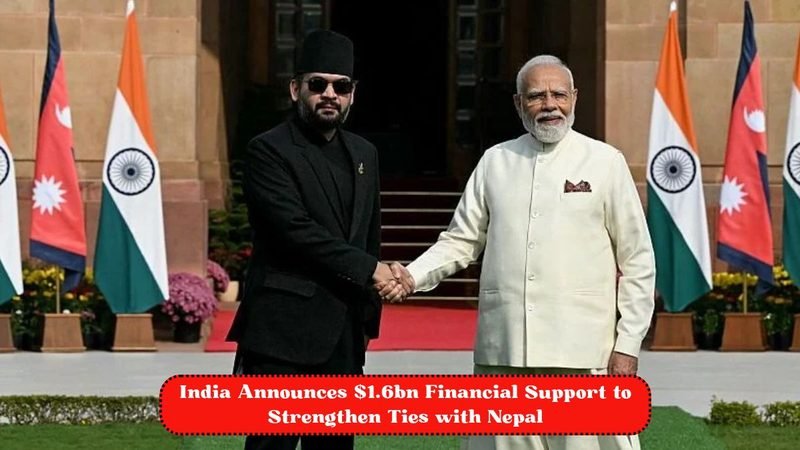
India and Nepal share centuries-old historical, cultural, and social ties. Beyond their geographical proximity, the two nations are bound by strong interpersonal connections, trade, shared religious beliefs, and familial relationships. In an effort to provide a new direction to this partnership, India has announced $1.6 billion in financial assistance to Nepal. This move is viewed as a significant initiative toward strengthening bilateral relations and enhancing mutual cooperation. The financial aid is expected to bolster Nepal’s development projects, economic activities, and infrastructure.
A New Beginning in India-Nepal Relations
Relations between India and Nepal have long held special significance. An open border, cultural commonalities, and robust people-to-people ties serve as the core strengths of this relationship. However, in recent years, certain differences have emerged between the two nations over various issues. Against this backdrop, India’s announcement of $1.6 billion in financial assistance is being seen as a sign of a fresh start. This initiative could play a pivotal role in restoring trust and opening new avenues for cooperation between the two countries.
India’s Significant Role in Nepal’s Development
Nepal holds immense development potential, yet it continues to face challenges related to infrastructure, energy, transportation, and economic resources. India has long supported Nepal’s development, with significant contributions in areas such as road construction, power projects, healthcare, and education. This new $1.6 billion in financial assistance could help Nepal advance its development agenda, potentially improving the country’s economic situation and fostering positive changes in the lives of its people.
Strengthening Economic Cooperation
Trade relations between India and Nepal are of great importance to the economies of both nations. Nepal relies on the Indian market for many essential commodities, fuel, and industrial goods, while for India, Nepal is an important neighboring trading partner. This announcement of financial assistance could provide an opportunity to further economic cooperation between the two nations. Through improved investment, trade facilitation, and development projects, new employment opportunities could be created. Additionally, local industries in Nepal are also likely to receive a boost.
Focus on Infrastructure Development
Strong infrastructure is essential for the economic progress of any nation. Facilities such as roads, bridges, railways, air connectivity, and power form the foundation of development. In Nepal, improving transport and connectivity has always been a significant challenge due to its mountainous geography. India’s financial assistance could help advance such projects. Better road connectivity and transport facilities will not only make travel easier for people but also provide new momentum to trade, tourism, and local businesses.
Growing Potential for Cooperation in the Energy Sector
Nepal possesses immense potential for hydroelectric power generation. Its rivers and natural resources provide a vital basis for electricity production. India and Nepal are already collaborating in the energy sector, and electricity trade between the two countries is on the rise. New financial assistance could create opportunities to advance energy-related infrastructure and projects. If cooperation in this sector is developed effectively, Nepal could increase its power generation capacity, while also helping India secure access to clean energy.
Efforts to Build Trust in Diplomatic Relations
The relationship between India and Nepal extends beyond mere economic cooperation. Political and diplomatic ties between the two nations are also crucial for regional stability. At times, border disputes and other political issues have led to tension in their bilateral relations. In this context, the announcement of significant financial assistance from India can be seen as an effort to strengthen mutual trust. Better communication and regular dialogue between the leadership of both countries could help resolve long-standing differences.
Potential benefits for the ordinary citizens of Nepal
The true success of any international economic agreement is measured by whether its benefits reach the common people. A large portion of Nepal’s population resides in rural areas, which still lack adequate healthcare, education, transport, and employment opportunities. If the financial assistance announced by India is utilized for projects that serve the public interest, local communities could directly benefit. Improved hospitals, schools, roads, and electricity infrastructure would make daily life easier for the people. Furthermore, this could also provide a boost to small businesses and local employment
Promoting Regional Cooperation in South Asia
Strong relations between India and Nepal are significant for the entire South Asian region. Enhanced cooperation between the two nations can boost trade, investment, and connectivity within the region. Nepal’s geographical location grants it a pivotal position in South Asia. A robust partnership with India can foster Nepal’s economic development while simultaneously improving regional connectivity. Such initiatives can help cultivate an environment of cooperation and stability among neighboring countries.
Considering Regional Dynamics Involving China
Due to its geographical location, Nepal holds strategic importance for both India and China. In recent years, China has also increased its involvement in infrastructure and other development projects within Nepal. In this context, India’s announcement of $1.6 billion in financial assistance can be viewed as significant from the perspective of regional diplomacy. However, it would be inappropriate to view India-Nepal relations solely through the lens of regional competition. The partnership between the two nations is rooted in historical ties, mutual trust, and shared developmental needs.
New Prospects for the India-Nepal Partnership
India’s announcement of $1.6 billion in financial assistance has the potential to steer the relationship between the two countries in a new direction. The actual impact of this initiative will depend on how the funds are utilized and how effectively the development projects are implemented. Transparency, timely completion of projects, and prioritizing local needs will be crucial to the success of this partnership. If India and Nepal move forward with mutual trust and cooperation, their relationship will extend beyond mere economic assistance, potentially serving as a strong foundation for long-term development and stability for both nations..