
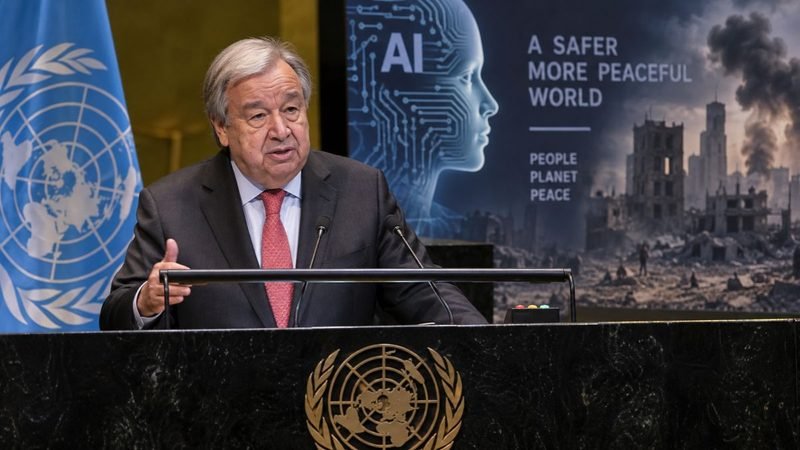
In his final General Assembly address, the UN chief expressed grave concern regarding two major challenges facing the world: escalating wars and rapidly evolving Artificial Intelligence (AI) technology. He urged world leaders to recognize that technological progress must be accompanied by responsibility and called for concrete efforts to resolve ongoing conflicts. His address came at a time when many parts of the world are grappling with political tensions, war, and humanitarian crises.
Emphasis on global challenges in the final General Assembly address
The UN chief discussed the current state of the world extensively in his final General Assembly speech. He stated that the international community must take effective steps to resolve problems rather than merely discussing them. War, instability, and rapidly changing technology have created new challenges for the global order.
Concern over the growing impact of AI
Artificial intelligence is no longer confined to the technology sector; its influence is rapidly expanding into areas such as education, employment, the economy, security, and communication. The UN chief highlighted that if AI develops without proper regulations and oversight, it could have serious social and security-related consequences.
The need for appropriate control over AI
The address emphasized the need for clear regulations and responsible use of AI. The objective is not to halt technological development but to ensure that AI is used in a manner aligned with human interests. Establishing shared international rules for this rapidly evolving technology could become a crucial issue in the near future.
Appeal to end wars
The UN chief also expressed deep concern over ongoing wars and conflicts worldwide. He called upon the international community to end violence and seek solutions through dialogue. Since ordinary citizens bear the brunt of wars, establishing peace must be a global priority.
Impact of conflicts on ordinary people
Wars are not limited to national borders or political leadership; they directly affect ordinary families, children, women, and the elderly. Issues such as displacement, shortages of food and healthcare facilities, and economic losses can impact people’s lives for a long time. This human dimension was highlighted in the UN address.
Responsibility of Global Leaders
The UN chief urged world leaders to act with greater responsibility and cooperation. While individual nations may have differing interests, challenges such as war, the climate crisis, technological shifts, and humanitarian crises transcend borders. Therefore, cooperation among nations is essential to resolve them.
Ethical Responsibility Alongside Technology
The debate surrounding AI is not limited merely to its capabilities; it also concerns how the technology is used and for what purposes. Transparency, safety, and human rights are considered crucial in the responsible development of AI. The UN’s message points toward this broader concern.
The Path of Dialogue for Peace
Dialogue and diplomacy play a vital role amidst conflicts. A key message from the UN chief’s address was that solutions to conflicts must be sought through dialogue, cooperation, and international efforts. Efforts must be directed toward achieving lasting peace rather than perpetuating long-standing conflicts.
A Need for New Thinking in a Changing World
Today’s world differs significantly from that of a few decades ago. Technologies like AI are evolving rapidly, while political and military tensions are rising in various regions. In such times, global institutions and nations must re-evaluate their policies and modes of cooperation to align with these changing circumstances.
A Final Appeal to Place Humanity at the Center
The overarching message of the UN chief’s final General Assembly address centered on human security, peace, and responsible technological development. The call to regulate and responsibly use AI, alongside the plea to end wars, underscores that the goal of global progress should not be limited to technological or economic advancement. Ultimately, the success of any international policy should be measured by the extent to which it benefits ordinary people and future generations.
Conclusion
Overall, this address highlights two distinct yet significant issues facing the world: the rapidly growing impact of AI and ongoing conflicts. The message is clear: responsible regulations must accompany technological advancement, and peace efforts amidst conflicts must be prioritized. Both global regulations for AI and international peace initiatives are likely to remain key topics of discussion in the coming years.