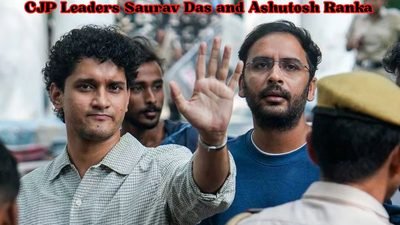

The members of Cockroach Janata Party (CJP) including Saurav Das and Ashutosh Ranka were ordered to be released from judicial custody in New Delhi on 21st October 2026 after filing a written undertaking before a Special Executive Magistrate. They promised that no calls would be made for protesting against the government at Jantar Mantar till the place is de-notified as a site for protesting. They promised that they will not disturb peace and their future protests would be according to the Constitution.
This order was passed by the court after the Delhi Police made an application for extension of their custody in preventive proceedings regarding a demonstration held at Jantar Mantar. The court considered the written assurances along with the oral submissions made to the court and found that peace bond and the assurance of the leaders was sufficient at this point in time.
The inquiry has not concluded. Das and Ranka have been directed to comply with the conditions of their bonds, appear at each hearing, and maintain public peace. The next hearing is scheduled for October 23, 2026, at 3 PM, according to published reports.
What Did Saurav Das and Ashutosh Ranka Promise the Court?
The key issue in this case of the CJP leaders is the written assurance given by both the leaders before the Special Executive Magistrate at Delhi. The assurance is that neither of the two leaders shall indulge in any breach of peace nor call for any demonstration at Jantar Mantar since it is a de-notified place.
In addition, they had trust in the justice system and its institutions. Their resolution included the declaration that their protest, if any, would be done within the constitutional boundaries. This assurance was noted by the magistrate while deciding about the necessity of preventive custody.
It is important because it lays down certain things that the leaders need to follow in their ongoing discussions. But it is also important to make sure that the declaration does not imply a general ban on all kinds of protests in Delhi. The particular promise has been made with regard to protests at Jantar Mantar until it remains a de-notified area.
Key Details of the CJP Leaders’ Case
| Detail | Information |
| Leaders involved | Saurav Das and Ashutosh Ranka |
| Organisation | Cockroach Janata Party (CJP) |
| Location | New Delhi |
| Authority hearing the matter | Special Executive Magistrate |
| Main undertaking | No calls for protests at Jantar Mantar while it remains de-notified under law |
| Other condition | Maintain peace and public tranquillity |
| Release conditions | Personal bonds and surety bonds of ₹50,000 each |
| Status of inquiry | Ongoing |
| Next reported hearing | October 23, 2026, at 3 PM |
The details above are based on reporting about the magistrate’s October 21 order. The official order remains the primary reference for the precise legal conditions.
Why Were the CJP Leaders Detained?
This case arose due to a protest held at Jantar Mantar on October 13, 2026. It is claimed that the members of CJP protested against the alleged malpractices in the SIR process of electoral rolls and asked for the resignation of the Chief Election Commissioner, Gyanesh Kumar. It has been claimed that even after being designated as a site where no protests could be held, protesters entered into the area. Police officials were allegedly obstructed in the process.
The leaders were taken into judicial custody as part of preventive action proceedings initiated by the Delhi Police. It was stated that the proceedings included Sections 126 and 170 of the Bharatiya Nagarik Suraksha Sanhita (BNSS). There had been continued apprehension regarding the possibility of a breach of peace.
Defence raised questions on the grounds of further detention. In the proceedings that followed, the leaders gave undertakings in writing about their peaceful conduct during future demonstrations. The magistrate then had to decide whether the objective could have been achieved through giving of bonds and undertakings.
This is important because preventive proceedings deal with issues related to the potential breach of peace whereas allegations relating to any incident have to be sorted out through the relevant legal procedure. The order of release was not an indication that the investigation was over.
What Is the Jantar Mantar De-Notification Issue?
The Jantar Mantar located in New Delhi has a rich history of having served as the site for many protests, campaigns, and other political activities. It should be noted, however, that the history of a particular site being used as the site for protests does not mean that all forms of protests can be held there.
However, in the present scenario, the said initiative is related to Jantar Mantar staying de-notified as a protest area in compliance with the law. The leaders have also decided not to call for protests at that place where the said conditions hold true.
What organisers and participants need to do is make sure that they know the legal standing of the potential place of their demonstration beforehand. The requirements may vary depending on the area, the kind of the demonstration being planned, and the instructions given by the corresponding authorities.
The case at hand is yet another example of how important it is to pay attention to the precise wording used in court orders. The undertaking provided by two people cannot be viewed as a blanket prohibition for everyone else. Everyone intending to hold a public event needs to have accurate information about the required permits.
Why Did the Magistrate Order Their Release?
On October 21, the Special Executive Magistrate took into account the plea made by the Delhi Police to grant another three days extension for the judicial custody. Police cited apprehensions over peace and public order, while the leaders assured in writing on those apprehensions.
Having examined the pledges and assurances made, the magistrate felt that there would be no need for the preventive action to be taken to be guaranteed by way of bail and bond alone.
Das and Ranka were instructed to provide personal bonds and surety bonds worth ₹50,000 each, until the end of the investigation. Upon accepting the bonds and the sureties, the magistrate released them and provided them with the release warrant.
The investigating officer was also directed to submit a verification report concerning the sureties at the next hearing. The leaders and their sureties were required to remain present as directed, and the leaders must attend each subsequent hearing and comply with their undertakings.
Their release should therefore be understood as a decision about the need for continued custody at that stage, subject to conditions. It was not a final decision closing the inquiry or resolving every issue arising from the protest.
What Happens Next in the CJP Leaders’ Case?
The next hearing that will take place is set for October 23, 2026, at 3 PM. The hearing is expected to have the necessary verification of sureties as well as discuss the on-going investigation. It is mandatory for the leaders to attend as directed by the magistrate.
The next hearing may clarify procedural progress, but it would be premature to predict the final outcome. The inquiry continues in accordance with law, and further developments will depend on the proceedings and any subsequent directions issued by the competent authority.
Readers following the CJP leaders’ latest news should distinguish between a release order, an interim preventive measure, and a final determination of any allegation. These are different stages of a legal process and should not be treated as interchangeable.
What Does This Case Mean for Future Jantar Mantar Demonstrations?
This case brings out the need for knowledge about the legal status of venues used for assemblies and compliance with the relevant instructions. Those wishing to hold demonstrations need to establish if the venue selected is a legitimate one for holding demonstrations and if there are any other requirements.
It is true that the task that falls on the leaders is unique in the sense that it is in relation to their commitment as well as the present state of affairs of Jantar Mantar. It cannot be assumed in isolation that all the peaceful protests in Delhi are illegal.
Peaceful public assembly is an important part of democratic participation, but it takes place within a legal framework. Organisers can reduce the risk of disputes by confirming venue conditions, communicating with the relevant authorities when required, and ensuring that participants understand applicable restrictions.
As for readers who want to stay updated on the news about the protests in Delhi, the best way is to read dated news items or read the official orders themselves. The headlines can misrepresent certain facts and procedures and therefore readers should check the complete news item or the official order if needed.
Conclusion
The CJP Leaders Jantar Mantar Protest case took a new turn on October 21, 2026, when Saurav Das and Ashutosh Ranka were ordered released after giving written undertakings before a Special Executive Magistrate in Delhi. They agreed not to call for protests at Jantar Mantar while it remains de-notified in accordance with law and undertook to maintain peace and follow constitutional limits.
Their release followed the acceptance of personal and surety bonds of ₹50,000 each. The inquiry remains ongoing, and the leaders must comply with the conditions imposed by the magistrate and appear for further proceedings, with the next hearing reported for October 23, 2026.
The key point is that the release order did not end the inquiry or create a blanket ban on every protest in Delhi. The case remains subject to the applicable legal process, and further developments should be assessed through official orders and reliable reporting.