
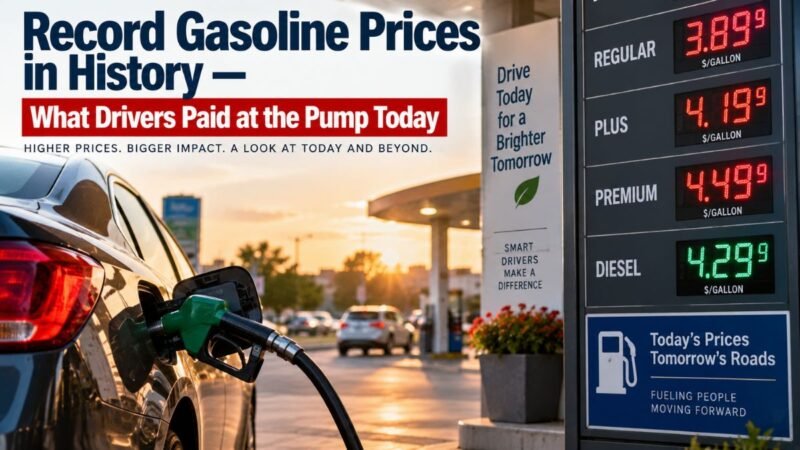
Rising petrol prices are once again impacting the budgets of drivers and ordinary families. When Gasoline petrol prices continue to rise, the impact isn’t limited to daily car or bike riders but also affects the cost of transportation, delivery, and many other services. The biggest question for many people at the pump today was how much they’re paying for a liter of petrol.
Record Prices Raise Concerns
If petrol prices reach near or above historic levels, it directly impacts consumer anxiety. For drivers who travel long distances daily, even a small price increase can become a significant additional expense by the end of the month. This is why news of record gasoline prices prompts people to re-examine their daily travel and fuel budgets.
What’s Shown at the Pump Today?
The most important aspect of today’s fuel pricing is that actual prices can vary depending on location, fuel type, and local taxes. Even within the same country or region, small price differences can be observed at different petrol pumps. Therefore, it is more useful for drivers to check the rates displayed at their nearest station rather than just looking at the headline price.
Rising prices directly impact driving costs
The most immediate impact of rising petrol prices is on the cost of operating cars and motorcycles. For example, if a person uses their vehicle daily for work or other essential activities, they may have to pay more each time they fill up. If prices remain high for a long time, this additional expense can also impact the amount available in the household budget for other needs.
Short-distance commuters can also be affected
It is often believed that fuel price increases only impact those who travel long distances daily, but this is not entirely true. Even those who travel short distances face rising fuel prices. Especially when grocery shopping, office travel, school runs, or other short trips are regular, fuel consumption can accumulate significantly over a month.
Impact on Other Costs, Not Just Petrol
Significant changes in fuel prices can also affect transportation costs. Operating expenses for freight companies, delivery services, and other vehicle-based businesses can increase. Over time, this can also impact the prices of some products and services. This is why viewing gasoline prices solely as a number at the pump isn’t sufficient.
Drivers are now using fuel more cautiously
Expensive gasoline may force people to pay attention to their driving habits. Many drivers adopt strategies like reducing unnecessary trips, completing multiple tasks at once, and avoiding traffic-heavy routes. Maintaining proper tire pressure, avoiding sudden acceleration, and getting regular vehicle maintenance can also help improve fuel efficiency. Consistently following small habits can be useful in controlling fuel costs in the long run
Why might gasoline prices rise so much?
Gasoline prices are influenced by many factors. Global crude oil prices, supply and demand, refining costs, transportation expenses, currency movements, and government taxes can all play a role. Therefore, the price shown at the pump isn’t solely a result of crude oil prices. This is why changes in the international energy market can be reflected in local fuel prices over time.
Could prices ease soon?
The future of fuel prices is difficult to predict with certainty, as energy markets depend on many rapidly changing factors. If crude oil prices or supply conditions change, gasoline prices could see either a further increase or a further decrease. Therefore, it wouldn’t be correct to assume that today’s record price will remain the same forever.
Quick Review for Driver
Overall, today’s record gasoline prices are an important reminder for drivers about how quickly fuel costs can impact household and daily travel budgets. The impact of increased fuel prices at the pump extends beyond just filling up the tank but can also extend to transportation and everyday expenses. Comparing local fuel rates, reducing unnecessary trips, and focusing on vehicle fuel efficiency can be practical steps for drivers during these times. While actual prices may vary in different locations, steadily rising fuel costs make it clear that efficient driving and better expense planning will be more important than ever in the future.