
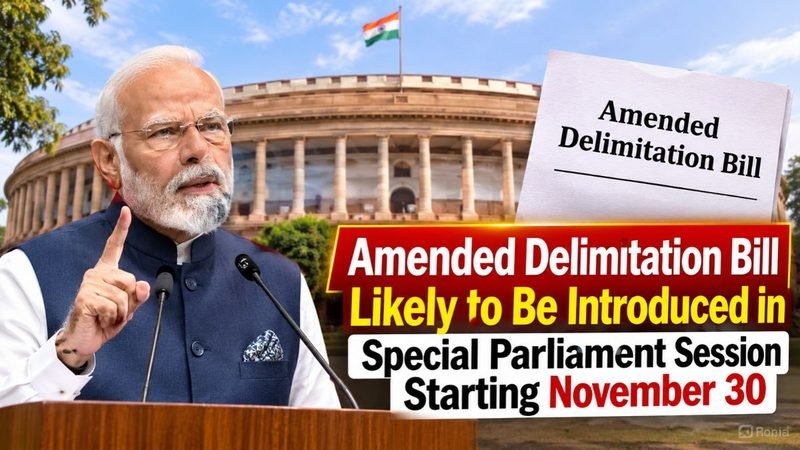
The issue of delimitation has once again come to the forefront of national politics. According to reports, the central government may introduce an ‘Amended Delimitation Bill’ during the special session of Parliament, which is set to begin on November 30. This potential move is considered highly significant for Indian politics and the electoral system. Delimitation is directly related to the demarcation of boundaries for Lok Sabha and Legislative Assembly constituencies. It determines who will represent a given area and how seats are allocated based on the number of voters in different constituencies. The prospect of this amended bill being introduced has sparked a fresh debate within political circles.
Special Session of Parliament to Begin on November 30
Political activity has intensified following reports that a special session of Parliament may commence on November 30. This session could see discussions on several critical issues, and the ‘Amended Delimitation Bill’ might also be part of the government’s agenda. However, official confirmation regarding the introduction and discussion of the bill is still awaited. With the special session approaching, political parties are closely watching the government’s strategy and the upcoming legislative proceedings.
What is the Delimitation Bill?
Delimitation refers to the process of redrawing the boundaries of electoral constituencies. In India, the boundaries for Lok Sabha and Legislative Assembly constituencies are determined based on population data and constitutional provisions. The primary objective is to ensure that every region receives fair political representation. As population demographics shift over time, a need may arise to adjust the boundaries of these constituencies; this process is known as ‘delimitation.’
Heightened Political Discourse Surrounding the Amended Bill
The possibility of introducing an ‘Amended Delimitation Bill’ is likely to fuel further discussion among political parties. Delimitation is not merely about the boundaries of electoral constituencies; it also has the potential to impact political representation and electoral equations. Differing perspectives may emerge across various states regarding population ratios and representation. Consequently, the roles of both the government and the opposition will be significant concerning this bill.
Potential impact on Lok Sabha seats
The most critical aspect of the delimitation process concerns representation via Lok Sabha seats. Changes to the boundaries of constituencies could alter the political landscape in certain areas. However, any modification to the number or structure of seats must adhere to constitutional provisions and established procedures. Should a revised bill be introduced in Parliament, one can expect a detailed discussion on its provisions.
The issue of state representation will remain crucial
Maintaining a balance of representation among states is a key consideration during the delimitation process. In a vast and diverse nation like India, states differ significantly in terms of population, geography, and political circumstances. Naturally, any changes related to delimitation are bound to be discussed through the lens of state representation—a point likely to receive heightened attention in states where there are specific concerns regarding population growth and political representation.
All eyes will be on the opposition’s response
The reaction of opposition parties to the revised delimitation bill could also prove significant. In Parliament, the government may face questions on this issue, and clarifications regarding the bill’s provisions might be sought. The opposition will likely want to understand the impact of the proposed changes on states, political parties, and the general electorate. Consequently, debates between the ruling party and the opposition may unfold during the special session of Parliament.
Potential for Changes in the Electoral System
The objective of delimitation is to make the electoral system more organized and to ensure balanced representation. Should changes be implemented through the delimitation process, they could affect constituency boundaries, the regional distribution of voters, and electoral strategies. Political parties might also need to recalibrate their strategies in light of new electoral equations. However, the actual changes will depend on the specific provisions of the bill and the legal procedures followed for its implementation.
Importance of the Constitutional Process
Any law or amendment concerning delimitation must adhere to constitutional provisions. India has an established legal framework for the delimitation process; therefore, the mere introduction of a bill does not automatically alter constituency boundaries. Such changes require the completion of the legislative process in Parliament, the securing of necessary approvals, and compliance with relevant legal provisions.
Why Is This Issue Important for the General Public?
The impact of delimitation is not confined to political parties or elected representatives; it directly concerns the general electorate. Alterations to constituency boundaries can change the areas to which voters belong and, consequently, their representatives. Furthermore, it can influence the level of political representation afforded to different regions. For this reason, any new initiative related to delimitation is also considered significant from the perspective of the general public.
All Eyes on the Special Session of Parliament
The prospect of a revised delimitation bill being introduced during the special session of Parliament—commencing on November 30—has once again brought this issue into the spotlight. All eyes will now be on the government’s official agenda, the actual provisions of the bill, and the ensuing parliamentary debate. Should the bill be introduced, it will be crucial to observe what changes the government proposes and what stance the opposition adopts. For now, the final details regarding the bill remain unclear; a clearer picture will emerge only once the proceedings of the special session unfold.