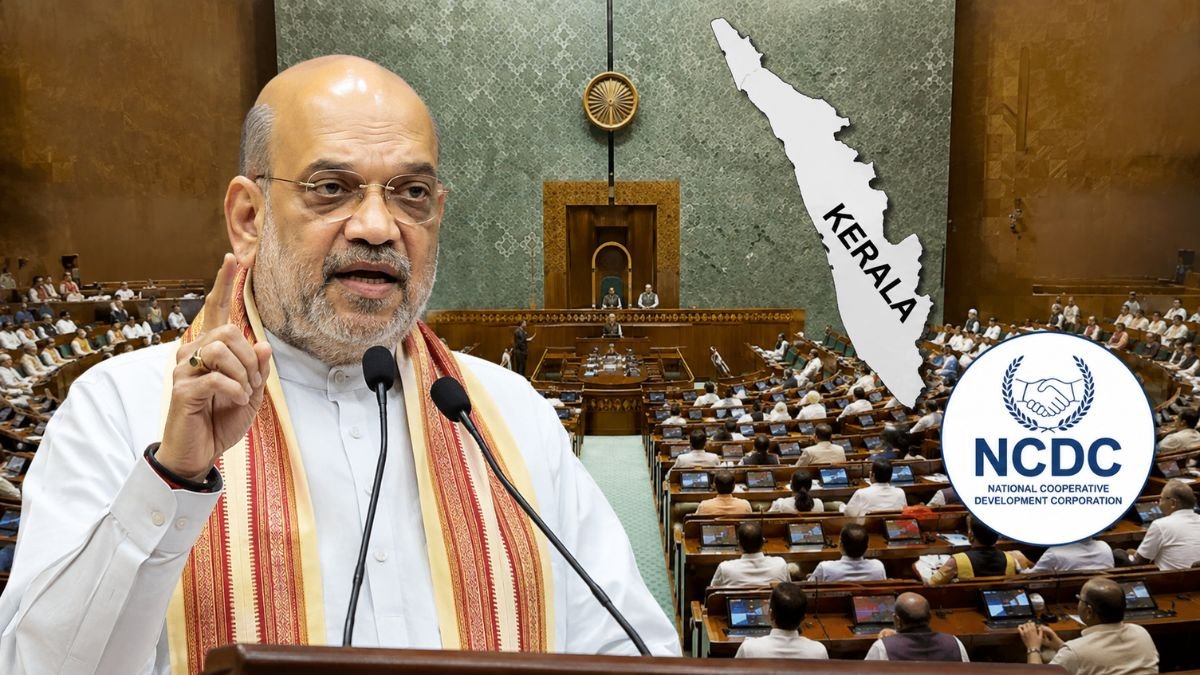
Today could prove to be a significant day in the country’s political landscape. Union Home Minister Amit Shah is expected to introduce bills in the Lok Sabha addressing two key issues. The first concerns a change in the name of Kerala, while the second reportedly relates to expanding the financial and funding powers of the National Cooperative Development Corporation (NCDC).
If these bills are introduced in the House, their impact will extend beyond mere parliamentary proceedings. The proposal regarding Kerala’s name could spark political and cultural debates, whereas the changes concerning the NCDC could prove vital for the country’s cooperative sector and rural economy.
Amit Shah may introduce key bills in the Lok Sabha today
Union Home Minister Amit Shah is expected to table these proposed bills in the Lok Sabha today. Introducing a bill in Parliament marks the first crucial step in the process of it becoming law. Once introduced, the bills will be subject to discussion, deliberation, and further parliamentary procedures within the House.
However, the introduction of a bill does not mean it immediately becomes law; it must undergo the prescribed parliamentary process before a final decision is reached.
Why is the issue of changing Kerala’s name significant?
The proposal to change Kerala’s name is likely to become the most discussed aspect of these developments. A state’s official name is not merely a matter of administrative identity; it is deeply intertwined with the state’s history, culture, language, and regional identity.
Consequently, if a bill regarding the renaming of Kerala is introduced in the Lok Sabha, it will draw the attention of political parties, the general public, and various social organizations alike. This issue could well become a subject of widespread debate outside Parliament as well.
The process of renaming is not simple
Changing a state’s name is not as simple as merely issuing a government order. It requires adherence to procedures prescribed by the Constitution and Parliament. The central government must place the proposal before Parliament and proceed in accordance with the relevant constitutional processes.
This is precisely why any bill concerning the renaming of Kerala is likely to undergo extensive discussion in Parliament. Members of Parliament can express their views regarding the political, administrative, and social implications of this move.
Focus on the political reaction in Kerala
The issue of a potential name change for Kerala could trigger significant reactions within the state’s politics. The state government, opposition parties, and various regional organizations may view this proposal from differing perspectives.
Political differences between the center and the state could also surface in such matters. Therefore, once the bill is introduced, not only the parliamentary proceedings but also the political reactions emerging from Kerala will be significant.
Another major aspect of the bill concerning the NCDC
The second key issue relates to expanding the financial powers of the National Cooperative Development Corporation (NCDC). The NCDC is a vital institution that provides financial assistance for the development of the cooperative sector in the country.
Cooperative societies in India play a major role in sectors such as agriculture, dairy, rural industries, food processing, and others. Consequently, changes to the NCDC’s financial capacity and operational scope could impact the country’s cooperative sector.
What does the expansion of the NCDC’s funding powers mean?
If the proposed changes are approved by Parliament, the NCDC could gain the opportunity to play a more extensive financial role. The objective may be to strengthen the access of cooperative institutions to financial resources.
Financial assistance is crucial for cooperative institutions operating in rural areas. An improved funding mechanism could potentially boost new projects, infrastructure, and production capacity.
Potential impact on farmers and the rural economy
Cooperative institutions play a significant role in India’s rural economy. Farmers often access agricultural credit, fertilizers, seeds, storage facilities, marketing support, and other services through cooperative societies.
In this context, expanding the NCDC’s financial powers could indirectly benefit farmers and rural businesses. However, the actual impact will depend on how the new financial framework is implemented and the extent to which the assistance reaches the intended beneficiaries.
What issues might arise during the parliamentary debate?
Once the bill is introduced in the Lok Sabha, the opposition may question the government regarding its objectives, necessity, and potential impact. Issues such as constitutional and regional identity may arise regarding the proposal concerning Kerala’s name.
Meanwhile, the bill related to the NCDC could spark discussions on funding transparency, the process of funds reaching cooperative institutions, and the exercise of financial powers. Detailed debate on such significant bills is a crucial part of the democratic process.
The nature of the two bills differs from one another
Interestingly, the two proposed bills deal with entirely different subjects. The issue regarding Kerala’s name is primarily linked to constitutional, administrative, and identity-related matters, whereas the NCDC issue pertains to the economic and cooperative sectors
Yet, both cases share a common thread: their implementation is likely to bring about changes in their respective fields. Therefore, the parliamentary debates and the arguments presented by the government will be crucial.
What happens next?
The biggest question now is the form in which Amit Shah introduces these bills in the Lok Sabha and the direction the parliamentary process takes thereafter. Once the bills are tabled, stages such as discussion, review, and voting are likely to follow.
Political debate is expected to intensify around the proposal to rename Kerala, while the NCDC bill is likely to focus on enhancing the financial capacity of the cooperative sector. Consequently, today’s parliamentary proceedings are considered pivotal for the future of both these issues.
Conclusion: Two distinct issues, both under scrutiny
The prospect of Amit Shah introducing bills in the Lok Sabha regarding the renaming of Kerala and the financial powers of the NCDC has made today’s parliamentary proceedings significant. On one hand, the renaming of Kerala is a sensitive issue tied to the state’s identity and history; on the other, expanding the NCDC’s funding powers could be a crucial step for the country’s cooperative and rural economic framework.
However, the final picture regarding these proposals will only become clear once the bills are tabled and the subsequent discussions take place. In the coming days, it will be interesting to observe the stances adopted by political parties on these issues and the arguments the government puts forward in support of its proposals.