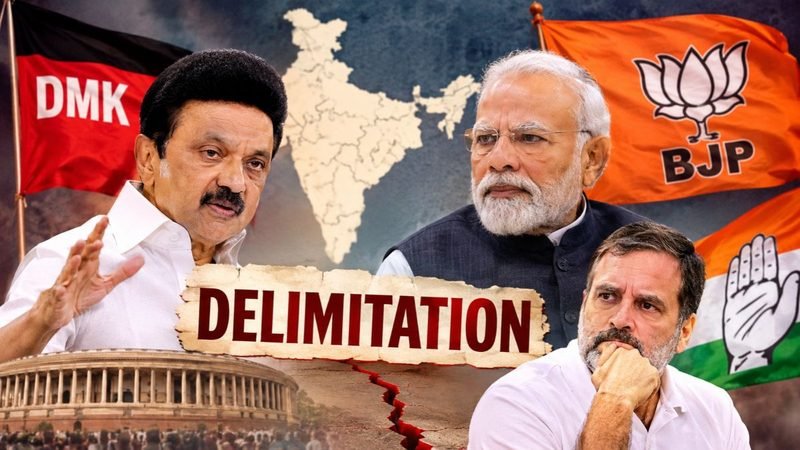
The issue of delimitation has once again taken center stage in Indian politics, creating new dynamics among the country’s major political parties. Notably, the ruling DMK in Tamil Nadu and the Bharatiya Janata Party (BJP) appear to hold similar views on the matter, while, conversely, political differences with the Congress seem to be deepening. The fact that parties—typically considered staunch adversaries in Indian politics—share a common stance on such a significant issue is politically noteworthy. This has sparked a fresh debate regarding opposition unity and the role of regional parties in national politics.
Delimitation: A Focal Point of Political Discourse
Delimitation refers to the redrawing of boundaries for Lok Sabha and Legislative Assembly constituencies to ensure that representation aligns with shifting population demographics. This process is vital to the nation’s democratic framework, as it directly influences the political weight of various states and regions. Consequently, political parties have consistently voiced their concerns and demands regarding the delimitation exercise.
Convergence Between the DMK and the BJP
Although the DMK and the BJP possess distinct ideologies and political priorities, they appear to share common ground on certain aspects of delimitation. Both parties view the issue through the lens of national politics and the representation of states. This alignment has fueled speculation in political circles about whether the issue of delimitation could potentially bring opposing parties onto a common platform.
Widening Political Rift with the Congress
Disagreements over delimitation between the DMK and the Congress could pose a challenge to their political alliance. While the two parties have frequently collaborated in the political arena, the emergence of divergent stances on critical national issues threatens to strain their relationship. The political equations emerging around this issue have posed a challenge for the Congress, requiring it to clarify its own strategy.
Concerns regarding the share of South Indian states
Several states in South India fear that relying solely on population as the basis for delimitation could diminish the political influence of states that have performed well in terms of population control. States like Tamil Nadu have consistently argued that their efforts in development, education, and population control should also be taken into account. This concern adds a layer of sensitivity to the debate on delimitation.
Why is delimitation significant for the BJP?
For the BJP, delimitation is not merely a matter of defining the boundaries of electoral constituencies; it is a crucial issue concerning national representation and the democratic framework. It is essential for the central government to understand the perspectives of various states and political parties on this matter. In this context, the alignment of views between the BJP and regional parties like the DMK on a specific issue can be seen as a significant development in national politics.
A new challenge for opposition unity
Both the Congress and the DMK play pivotal roles in opposition politics. Consequently, any divergence in their positions on the issue of delimitation could impact opposition unity. The primary challenge for opposition parties lies in formulating a common strategy that accounts for the specific political concerns of individual states. Failure to do so could weaken the cohesion of the opposition at the national level.
Potential impact on Tamil Nadu politics
In Tamil Nadu, the issue of delimitation is politically highly sensitive. The DMK views it through the lens of state rights and political representation. As such, the party’s stance could shape the future trajectory of both state-level politics and national-level alliances. Furthermore, competition among political parties may intensify as they strive to effectively articulate their respective positions to the public.
Evolving equations in national politics
In Indian politics, it is not uncommon for parties to converge on a particular issue, even if that stance deviates from their traditional ideological positions. The issue of delimitation appears to be a case in point. The convergence of views between the DMK and the BJP on this matter suggests that issues such as national interest, states’ rights, and political representation can, at times, transcend partisan opposition.
The challenge before the Congress in defining its strategy
For the Congress, this is the time to clarify its political strategy. While maintaining its stance on delimitation, the party must also give due weight to the concerns of its regional allies. Clarity is particularly essential regarding questions concerning the representation of South Indian states. If the Congress and its allies fail to reach a consensus on a shared approach, it could impact their future political partnership.
The Delimitation Debate Will Shape the Future Political Trajectory
Overall, the issue of delimitation is no longer confined to a mere administrative process; it has evolved into a subject that is forging new political equations within the country. The growing alignment between the DMK and the BJP on this issue, coupled with the widening rift with the Congress, represents a politically significant development. It will be interesting to observe whether this alignment leads to a major political shift or remains limited to this single issue. For now, it is clear that the debate over delimitation has the potential to influence national politics and Centre-state relations in the days to come.