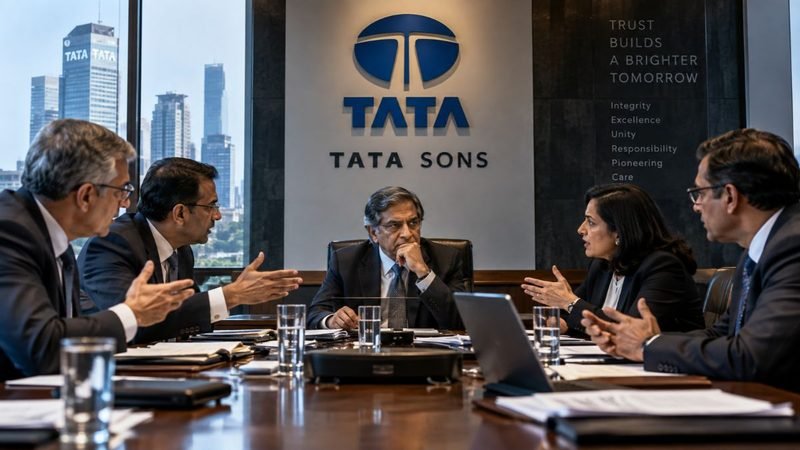
The ongoing boardroom dispute involving the Tata Group has evolved beyond a mere matter of leadership change. Differences between Tata Boardroom Sons and Tata Trusts regarding the reappointment of the chairman and the potential listing of the company have come to the fore. According to Reuters, Tata Trusts holds approximately a 66% stake in Tata Sons, while the Tata Sons board favors retaining N. Chandrasekaran as chairman for another five-year term.
The dispute began with leadership
In August 2026, N. Chandrasekaran announced his decision not to seek reappointment as chairman after the conclusion of his current term. At the time, Tata Trusts accepted his decision and initiated the process of selecting a new chairman.
Then, the situation changed
Subsequently, the situation shifted rapidly. The Tata Sons board approved a proposal to reappoint Chandrasekaran for a five-year term. Noel Tata, Chairman of Tata Trusts, opposed this decision and declared it legally invalid on behalf of the Trusts.
Tata Trusts and Tata Sons at odds
The most critical aspect of this dispute is that the Tata Sons board and its principal shareholder, Tata Trusts, currently hold divergent views on the same issue. The Trusts maintain that the role of Trust-nominated directors is pivotal under the Articles of Association regarding the appointment of the Chairman. Meanwhile, the board has proceeded with the proposal to reappoint Chandrasekaran.
Tata Sons’ listing is also a major issue
The second major point of contention concerns the listing of Tata Sons on the stock exchange. On September 17, Tata Trusts stated that it does not agree with the listing of Tata Sons and argued that all available options should be reviewed instead of listing the company. The Trusts contend that the current structure is integral to the Tata Group’s long-standing philanthropic model.
The RBI’s role is significant
Regulatory issues also play a crucial role regarding the potential listing of Tata Sons. According to Reuters, the RBI rejected Tata Sons’ attempt to alter its status in a way that would have allowed it to avoid potential listing requirements. Subsequently, the RBI filed a caveat with the Bombay High Court.
SP Group’s stake is also in focus
Amidst the dispute, the Shapoorji Pallonji (SP) Group’s approximately 18.4% stake in Tata Sons has also become a key point of discussion. Tata Trusts stated that the SP Group has proposed selling a portion of its stake at a minimum valuation of around ₹25,000 crore. Reports suggest the proposed transaction is intended to be completed in two phases.
Debate over the Tata Model
Tata Trusts maintains that Tata Sons’ current ownership structure is not merely a vehicle for business control; the dividends generated are also utilized for philanthropic activities. The Trusts have emphasized the model’s importance in supporting sectors such as healthcare, education, and research.
Chandrasekaran’s leadership back in the spotlight
N. Chandrasekaran has been leading Tata Sons since 2017. According to Reuters, the Tata Group has expanded into technology, semiconductors, and other sectors during his tenure. His potential third term will now depend on how the ongoing governance dispute between the board and Tata Trusts unfolds.
Legal and corporate processes ahead are crucial
Given the divergent stances of Tata Trusts and Tata Sons, upcoming boardroom and legal proceedings could prove significant. According to Reuters, the Annual General Meeting (AGM) scheduled for December could also mark a critical juncture in these developments. At this stage, it would be premature to draw definitive conclusions regarding the final outcome of the dispute.
Quick Review: What is the core issue?
In summary, the current dispute involving Tata Sons revolves around three major questions: the future of N. Chandrasekaran, the potential public listing of Tata Sons, and the governance role of Tata Trusts. Public statements from both sides indicate significant differences, yet the final situation is still evolving. Consequently, upcoming board decisions, regulatory measures, and potential legal actions will play a pivotal role in determining the direction of this entire matter.