
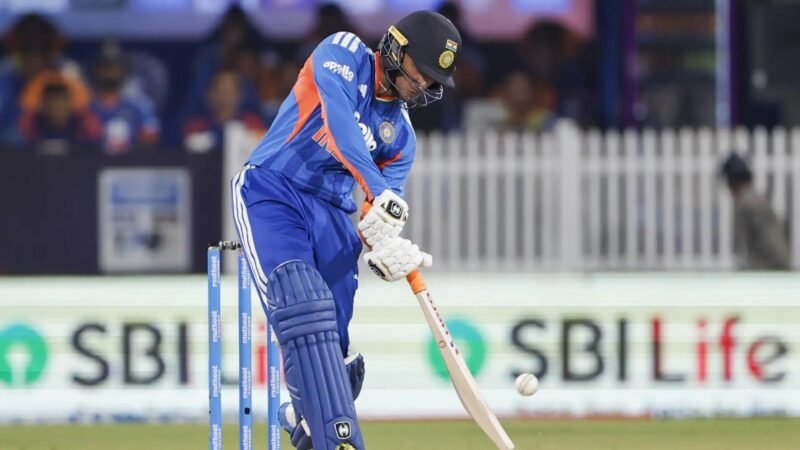
Abhishek Sharma’s aggressive batting once again caught everyone’s attention in the third T20 International match between India and West Indies. In this match played at Holkar Stadium in Indore, the Indian opener played a quick innings of 69 runs and played a vital role in taking the team to a strong score. After the match, Abhishek told that the West Indies bowlers had made a special plan against him, but he too had to perform better than that strategy by making changes in his batting. This statement has become the main reason for discussion about Abhishek Sharma West Indies Strategy.
India scored 223 runs in this match, and in response, the West Indies could only reach 209/7. India won the match by 14 runs and took a 2-1 lead in the five-match T20 series. Abhishek’s innings, his partnership with Ishan Kishan, and the crucial contributions of the Indian bowlers kept the match in India’s favor.
Abhishek Sharma West Indies Strategy: What was the plan of the bowlers?
After the match, Abhishek Sharma indicated that the West Indies team wasn’t bowling unprepared against him. The opposition bowlers were aware of his aggressive style and didn’t want to give him easy opportunities to play big shots. According to Abhishek, he had to keep in mind that the bowlers had come to the field with a plan. Therefore, it was important to understand the bowling and fielding conditions rather than relying solely on his strengths.
According to reports, West Indies initially used off-spin bowling and tried to control Abhishek’s shots by fielding on the off side. This strategy can be useful against the aggressive left-handed batsman, as the direction, turn, and field placement can affect his preferred shots. However, Abhishek read the conditions and looked for run-scoring options, not allowing the opposition’s plans to influence him.
Trying to stop Abhishek with off-spin and field placement
A key part of the bowlers’ strategy in the India vs. West Indies match was to prevent Abhishek from playing freely in the initial overs. Abhishek explained that when he faced off-spin bowlers, it became a challenge between him and the bowler. He also emphasized respecting the bowler in the initial overs, as he believed he had been bowling well in the series.
In T20 cricket, trying to hit a big shot on every ball isn’t always the right choice. Sometimes, a batsman needs to understand the bowler’s rhythm, assess the field, and manage risk. Abhishek’s innings reflected this aspect. Instead of relying solely on power, he played shots that suited the situation. When the fielding allowed, he also explored the off-side.
It’s worth noting that Abhishek didn’t limit his strategy to a specific shot. He said that many shots come naturally based on fielding conditions. This understanding helps an aggressive batsman counter the opposition’s plans.
Abhishek Sharma’s brilliant innings of 69 runs in the third T20I
Abhishek Sharma’s batting laid the foundation for India’s big score. He scored 69 runs to give the team a quick start and fulfilled his responsibility in the powerplay. His innings included six fours and five sixes. This performance demonstrated that aggressive cricket doesn’t mean taking risks on every ball, but also identifying the right delivery and capitalizing on it.
Abhishek formed a crucial second-wicket partnership with Ishan Kishan. Both batsmen scored quickly and put India in a strong position. Ishan Kishan also made a useful contribution, keeping the pressure on the opposition bowlers. This partnership helped India post a score that the bowlers had a competitive chance of defending.
The significance of Abhishek’s batting wasn’t limited to his individual score. When an opener scores quickly in the beginning, the rest of the team’s batsmen are better positioned to build on the innings. However, despite a high total, India faced West Indies’ aggressive batting in the final overs. This highlighted the importance of maintaining discipline in bowling even after posting a strong total in T20 matches.
What was Abhishek’s response to West Indies’ strategy?
Abhishek Sharma’s response suggests he’s focused on reading the opposition bowlers’ plans. He didn’t say every shot was pre-planned. Instead, he emphasized the importance of identifying opportunities by observing field placements and scoring the required runs in the powerplay. His approach was that if the opposition has a plan in place, the batsman must play better than that.
This aspect of Abhishek Sharma’s batting strategy is unique, as he is known for his fast scoring abilities. However, in international cricket, aggression alone isn’t enough. Bowlers study a batsman’s strengths and weaknesses, adjust fielding, and force him into errors by altering his pace or line. Consequently, the batsman must adapt his options to suit the situation.
Abhishek indicated a similar understanding. He didn’t describe his off-side shot as a completely pre-planned move, but admitted that he had an idea of the opposition’s strategy in mind. Thus, his innings can be seen not just as a story of big shots, but also as an example of adapting to the conditions against bowling.
The bowlers also played a vital role in India’s victory.
India’s victory wasn’t solely determined by Abhishek Sharma’s batting. West Indies, chasing the target, scored 209/7 and kept the match competitive until the end. The Caribbean team’s aggressive batting kept the Indian bowlers under constant pressure. Arshdeep Singh, who took three wickets, played a crucial role in India’s victory. Naman Dheer also impacted the opposition’s run-scoring rate by taking two wickets.
This match once again demonstrated that batting and bowling strategies are intertwined in T20 cricket. India scored quickly to build a strong total, while the bowlers had to prevent the West Indies batsmen from overtaking the target. The final result was in India’s favor, and the team took the series lead.
Abhishek, while describing the West Indies team as dangerous, also stressed the importance of not allowing the opposition to make a comeback at any point in the match. This philosophy is crucial in T20 cricket, as the match’s dynamics can change rapidly in just a few overs.
What will happen next in the IND vs WI series?
The victory in the third T20I gave India a 2-1 lead in the five-match series. The Indian team will now be looking to convert this lead into a decisive result. Meanwhile, the next match will be an opportunity for the West Indies to rethink their strategy and develop a more effective performance against the Indian batsmen.
This series is also an opportunity for Abhishek Sharma to showcase his aggressive batting, as well as his ability to read conditions and counter the opposition’s bowling plans. West Indies may again use off-spin, field placement, or other bowling options against him in the upcoming matches. However, the next strategy will only be confirmed before the match.
Conslusion
Abhishek Sharma’s 69-run innings was one of the key reasons for India’s victory in the 3rd T20I of IND vs WI. His statement after the match revealed that the West Indies had planned to restrict him, but Abhishek Sharma looked for opportunities to score runs by understanding the bowlers and fielding conditions.
India’s 14-run victory strengthened their lead in the series, while Abhishek’s innings demonstrated that aggressive batting is just as important as sound decision-making. All eyes will now be on the next match, where both teams will look to better implement their strategies.